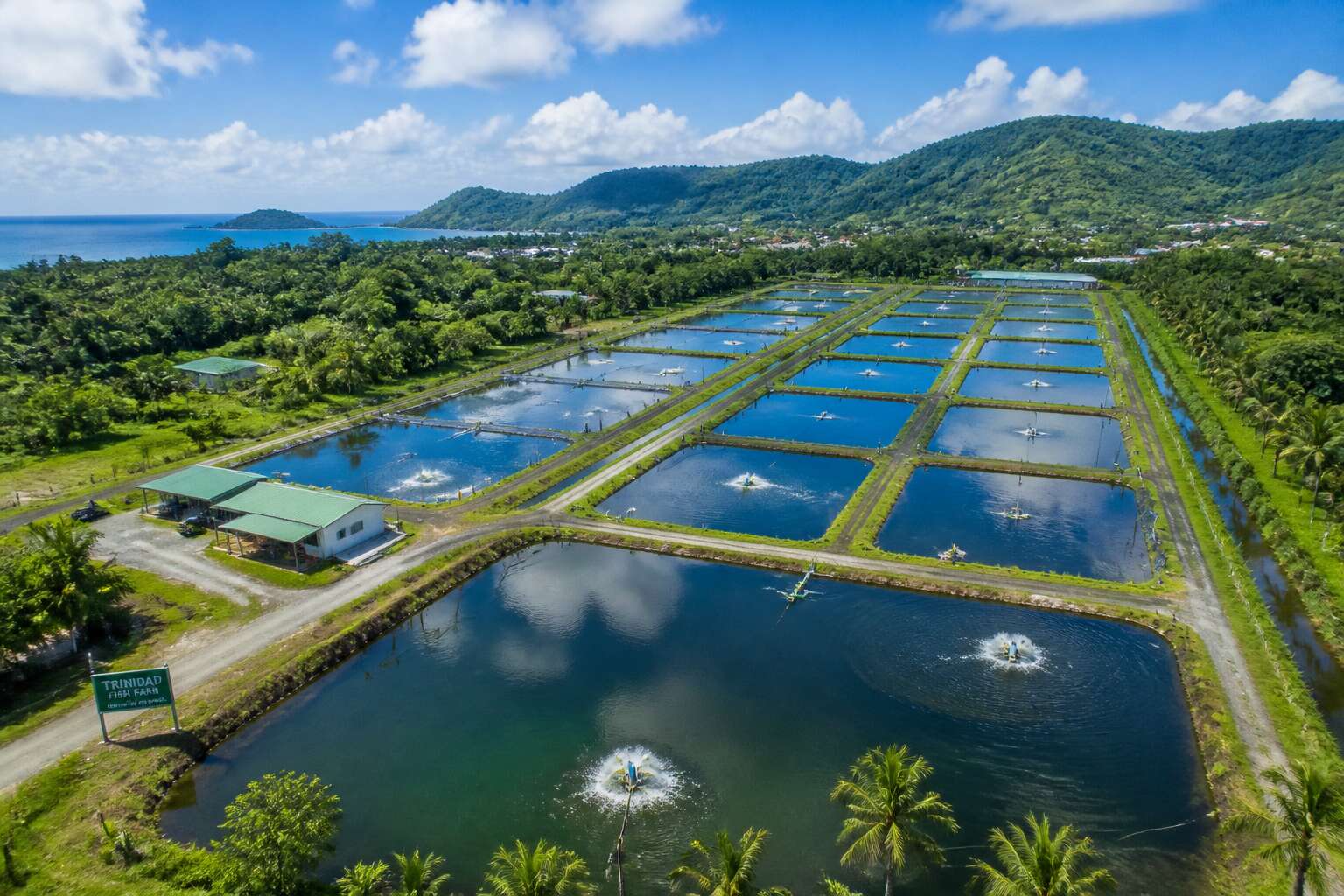
Overview of Aquaculture in Trinidad and Tobago
The Growth of Fish Farming in the Caribbean
Walking through Caroni Swamp last June, I counted ten floating cages where none existed five years ago. That shift mirrors a broader change across the Caribbean. Aquaculture in Trinidadand Tobago has moved from subsistence ponds to semi-commercial operations. Species like tilapia and cascadura thrive in the warm, shallow waters, offering steady protein without overfishing. A small fish farm in Trinidad typically uses cement tanks, making entry affordable for families.
- Government grants for fry production
- Solar aeration reduces reliance on diesel
- Caricom export routes open regional markets
Neighbours in Jamaica and Barbados tackle same problems: feed prices, disease outbreaks, and market access. Yet regional growth persists because aquaculture aligns with food security goals. As wild catches plateau, Caribbean farmers are building a resilient protein source.
Why Trinidad Is an Emerging Hub for Aquaculture
Trinidad’s aquaculture sector produces around 400 tonnes of fish per year, a figure that belies the island’s efficiency per hectare. Warm waters allow three grow-out cycles annually, drawing southern investors.
Most farms operate on small plots, blending earthen ponds with concrete tanks. Tilapia dominates, but native cascadura and hybrid red tilapia gain popularity! University research has developed salt-tolerant strains, opening coastal sites.
Infrastructure explains Trinidad’s rise. The port at Port of Spain sits within an hour of farming zones, and the grid supports continuous aeration. For a fish farm trinidad, expansion means adding tanks, not acquiring land. The typical setup includes:
- lined ponds to prevent seepage
- manual feeding for small batches
- rainwater harvesting
This compact model, paired with disease-free broodstock, positions Trinidad as a testbed for Caribbean aquaculture. A fish farm trinidad pivots to new species faster than larger producers.
Government Support and Regulatory Framework
The state holds the keys to every fish farm Trinidad, and it rarely fumbles them. The Ministry of Agriculture, Land and Fisheries issues permits through the Fisheries Division, with approval timelines of eight to twelve weeks for standard pond installations. The Aquaculture Unit offers technical guidance. The Agricultural Development Bank extends credit lines for equipment. A fish farm Trinidad can access duty free imports on aeration systems and feed under the Fiscal Incentives Act.
The framework demands:
– registration with the Fisheries Division
– environmental screening for coastal sites
– biosecurity compliance under the Veterinary Act
Enforcement stays pragmatic. Inspectors focus on disease prevention, not paperwork. That approach draws investors from Barbados and Grenada. Rules tighten when farms scale past five hectares, adding water abstraction licences and effluent monitoring. The system rewards serious operators, quietly culling the indifferent. For newcomers, the state’s hand is firm but fair, a rare balance in Caribbean agriculture.
Local Demand for Farmed Fish and Seafood
Trinidad imports more seafood than its coastal waters and ponds can provide. The aquaculture sector is compact but expanding, with tilapia, cascadura, and carite defining the local catch. For most households, fresh fish is a weekly staple, and demand climbs sharply during Lent and Easter.
Local buyers prefer whole fish, and they know their product. A fish farm Trinidad that delivers consistent quality can sell directly to supermarkets, hotels, and roadside vendors. Supply rarely matches weekly demand, which keeps prices steady.
Consider the species that dominate local farm ponds:
- tilapia, the most produced species on the island
- cascadura, sought after for its rich soup
- prawns and red hybrid tilapia, both rising in volume
Retail prices for farmed fish undercut imported options, yet consumers still queue for the freshest catch. I have seen weeknight stalls sell out before sunset, and that tells you everything about demand.
Key Fish Species Cultivated in Trinidad
Tilapia: The Backbone of Local Farms
Tilapia dominates Trinidadian aquaculture with good reason. In my years visiting farms, I have seen how this fish adapts to the island’s climate, reaching harvest size in under six months!
The red tilapia sells well at market, while the Nile tilapia withstands disease. Some farmers diversify with cascadura, a native catfish, but tilapia remains the anchor of every fish farm trinidad I know. Its feed conversion ratio beats most freshwater species, and its mild, flaky flesh appeals to local palates. Walking through a facility, you notice the steady rhythm of feeding and sorting, all revolving around this dependable fish.
Cascadura and Other Native Species
The cascadura, a benthopelagic catfish with a stubborn, armoured cranium, demands patience. I have watched farmers coax it through a slow growth cycle that tests economic endurance! While tilapia furnishes the bank balance, cascadura offers a premium for traditional soups. Diversifying across species requires careful water management, but the payoff mitigates price shocks.
Beyond cascadura, a small cadre of secondary species deserves attention for a fish farm trinidad:
- Pacu, which grazes on fruit and vegetable waste.
- Sunfish, a resilient alternative during dry spells.
- Freshwater shrimp, a high-value side crop.
Observing these native stocks reveals an unusual trade-off. Farmers who embrace polyculture must suppress the urge to force rapid turnover. The cascadura’s slow metabolism yields a flake texture that imported fillets cannot replicate. A farm that respects these biological rhythms builds durable resilience for the whole operation.
Shrimp and Prawn Farming Potential
Shrimp and prawn farming in Trinidad is the sector that keeps financial officers muttering. While tilapia steadies the ledgers, the real money hides in brackish water. A fish farm trinidad operation that focuses on crustaceans can triple its revenue per hectare, since local demand outstrips supply by a wide margin.
Two crustacean species dominate the potential:
- Litopenaeus vannamei, the saltwater white shrimp, thrives in coastal ponds.
- Macrobrachium rosenbergii, the giant freshwater prawn, tolerates heavy rainfall and turbid conditions.
Neither species requires fancy equipment. The farmers who succeed learn to manage oxygen levels with modest aeration. The payoff arrives in about four months, and the export market for whole prawns remains hungry.
Ornamental Fish for Export Markets
Ornamental fish for export represent a distinct commerce within the island’s aquaculture. Trinidadian wild guppies, with their chromatic intensity, attract buyers from Tokyo to Johannesburg. The unique genetic stock found in local rivers has made a fish farm trinidad operation special, because these specimens cannot be easily replicated elsewhere. The trade revolves around live fish, sealed in oxygenated bags, and the margin lies in quality, not quantity.
- The guppy, Poecilia reticulata, prized for pigment variation.
- The swordtail, Xiphophorus helleri, with its elongated fin.
- The angelfish, bred for gracile proportions.
Each shipment requires precise oxygen management and temperature control. Exporters rely on direct flights and careful documentation. A fish farm trinidad enterprise that focuses on ornamental species avoids the heavy competition of food fish markets, and international demand for these live fish remains steady.
Hybrid Species and Genetic Improvements
Trinidadian hatcheries now produce hybrid red tilapia that reach market size in six months. This genetic improvement stems from selective breeding programs focused on growth rate and disease resistance. A fish farm trinidad operation often pairs local broodstock with imported lines to achieve hybrid vigor.
Specific crosses yield traits such as:
– Higher fillet yield
– Tolerance for brackish water
– Uniform size at harvest
These hybrid species reduce mortality and feed costs. Researchers at the University of the West Indies have documented measurable gains in stress tolerance.
Meanwhile, ornamental species benefit from color enhancement through careful line selection. Genetic improvements in guppies and angelfish now produce stable pigment patterns that export buyers expect.
Setting Up a Fish Farm in Trinidad: Essential Considerations
Choosing the Right Location and Water Source
Choosing a site for a fish farm trinidad is equal parts science and property shopping. Water source determines everything. Aquaculture demands consistency, not just purity. You negotiate with rainfall, predators, and neighbors who think your pond is a dump.
Consider these factors:
- Groundwater access with stable pH levels
- Proximity to municipal supply for emergencies
- Natural drainage away from flood zones
Surface water from rivers carries wild fish and parasites. Boreholes offer control but cost money to drill. Soil composition matters. Clay holds water, sand drains it. Test before you dig. A hillside farm might look scenic, but pumping water uphill drains your wallet faster than a hungry tilapia. For a fish farm trinidad, the real estate mantra is location, location, hydrology.
Pond Construction and System Design
Digging a pond for a fish farm trinidad demands more than a backhoe. Earthen ponds are cheaper and grow natural feed, while lined tanks give you control over water quality. For a fish farm trinidad, the choice depends on your species and capital. Most small operations in Trinidad start with earthen ponds, then upgrade later.
Depth influences temperature and oxygen. Too shallow, and afternoon sun heats the water into danger. Too deep, and the bottom turns anoxic. A steady two to three meters works best with diffused aeration.
- Clay bottoms hold water better than sandy soil
- Drain lines at the lowest point allow full harvest
- Screened inlets block river fish and parasites
Recirculating systems raise more fish in less space but depend on constant electricity. Trinidad’s grid is reliable in urban zones, less so in rural valleys. Design with overflow spillways to manage heavy rains. These choices define your daily workload and your survival through a wet season.
Water Quality Management and Aeration
A fish farm trinidad can lose more stock to a silent oxygen crash than to any disease. Levels dip below 3 mg/L at dawn in deep ponds with heavy feed loads. That is the threshold where tilapia start gasping. You need aeration that matches your pond shape and stocking density.
Surface aerators are simple but they raise water temperature. Diffused air systems push bubbles from the bottom, creating vertical mixing without heating. I have watched farmers lose harvests to a single silent power cut. Here is what every operator should watch:
- Dissolved oxygen at dawn and dusk
- Ammonia and nitrite weekly
- pH stability between 6.5 and 8.5
Trinidad’s limestone filled water sits at pH 8.0, but heavy rains can knock it down. On a fish farm trinidad, that shift can trigger an ammonia spike. Recirculating systems need constant oxygen for biofilters. A generator for backup aeration is not a luxury!
Feeding Strategies and Nutrition
Setting up a fish farm trinidad demands careful attention to biosecurity and feeding protocols. A single contaminated net can undo months of preparation. I have watched operations collapse from overfeeding, not from water quality failures. Nutrition shapes growth rates, immune response, and final flesh quality. In this context, local ingredients such as rice bran and copra meal can cut costs, but they need precise protein balancing. For feeding, use this schedule as a baseline:
- Feed twice daily at consistent times.
- Monitor feed conversion ratios weekly.
Tilapia require a 28% protein diet, while juveniles need 32%. Overfeeding pollutes the water, underfeeding stunts growth. Floating pellets let you observe intake directly. Store feed in dry, cool spaces to avoid mycotoxin buildup. A fish farm trinidad succeeds through disciplined feeding, not elaborate machinery.
Disease Prevention and Biosecurity
Disease rarely announces itself with visible cues. In an intensively managed fish farm trinidad, a pathogen can spread through one contaminated net or a single unchecked water source. Biosecurity means preventing introduction and spread of pathogens, not reacting after an outbreak.
Common entry points include new stock, shared equipment, and wild birds. To manage these, adopt these protocols:
- Quarantine new stock for at least two weeks in isolated tanks
- Disinfect all nets, boots, and equipment between ponds
- Filter or settle incoming water to remove carriers
Routine health checks should inspect skin, gills, and feeding response. Weak fish often show lowered appetite before clinical signs appear. This is where feeding records become diagnostic tools. A sudden drop in feed intake signals stress or infection. Daily observation and logging, already part of a sound feeding program, doubles as disease surveillance. In a fish farm trinidad, biosecurity depends on routine, not on complex laboratories.
Licensing, Permits, and Compliance
Starting a fish farm trinidad requires more than digging ponds and stocking fingerlings. The legal framework determines whether your operation survives its first season. In Trinidad and Tobago, the Aquaculture Unit under the Ministry of Agriculture issues the necessary permits. You will need to register the farm, secure water abstraction rights, and obtain environmental clearance if your site exceeds a certain production capacity.
Expect a process that takes several months. You should prepare site plans, water source assessments, and a waste management proposal. The following documents are typically required:
- Proof of land tenure or lease agreement
- Water use permit from the Water Resources Agency
- Environmental impact assessment for larger operations
- Fish health certificate for imported stock
Without these, your fish farm trinidad faces closure or fines. Compliance is not bureaucratic noise; it protects waterways and neighboring farms. Work with a local fisheries consultant early to avoid costly revisions.
Challenges and Solutions for Local Fish Farmers
Climate and Seasonal Variability
Trinidad does not do subtle seasons. One week you’re wading through a flood, the next you’re scraping dried mud off your gumboots. For any fish farm trinidad operation, this variability is the central challenge. The dry season drains ponds and spikes water temperature, while torrential rains crash pH levels and flush out feed. I’ve seen farmers lose more stock to a sudden downpour than to any disease.
The solution is planning for the extreme, not the average. A feeding schedule that adjusts to temperature is crucial. Practical steps include the following:
- Install backup aeration for oxygen crashes.
- Excavate deeper ponds to buffer shifts.
- Build a secure water storage reserve.
- Adjust feeding rates based on temperature.
When the water cools, the fish lose their appetite. For a fish farm trinidad, adapting to this rhythm separates the survivors from the ones filing bankruptcy paperwork.
High Feed Costs and Import Dependency
Feed costs account for roughly 70% of operating expenses at any fish farm trinidad, a figure that climbs higher when import prices surge. Imported pellets remain the standard, but their cost leaves local farmers exposed to exchange rate swings and shipping disruptions.
Smart operators respond by reducing their reliance on foreign feed. Some blend their own rations using copra meal, rice bran, and locally caught fish waste. Others experiment with duckweed cultivation to replace a portion of protein content. Practical steps include:
- Testing feed formulations with local ingredients
- Building partnerships with agricultural suppliers for bulk discounts
- Investing in on-farm feed mills
These tactics do not solve import dependency overnight, but they reduce the impact. A resilient operation plans for feed price volatility by diversifying its inputs, ensuring survival when global markets shift.
Limited Access to Technical Training
Limited access to technical training leaves many producers isolated from modern husbandry methods. Practical skills like water quality monitoring, broodstock conditioning, and disease recognition are rarely taught outside formal institutions. A farmer in a fish farm trinidad often relies on anecdotal advice from traders or input suppliers. That knowledge has limits, especially when managing off-season spawning or larval nutrition. The consequences appear as slow growth rates, recurring mortality events,and wasted capital.
Extension services exist but reach few operations. Government workshops happen twice a year, mostly in Port of Spain. Rural farmers cannot travel, cannot leave ponds unattended. This spatial inequity compounds the risk of outdated practices. Some producers have formed informal clusters, exchanging troubleshooting notes over messaging apps. These peer groups offer small wins, yet they cannot replace structured curricula. For lasting improvement, training must arrive on site or through mobile units. A resilient fish farm trinidad depends on accessible knowledge in addition to physical infrastructure.
Market Price Fluctuations and Distribution
Market prices for farmed fish in Trinidad swing sharply with seasonal gluts and import surges. A fish farm trinidad faces thin margins when distributors dictate terms. Distribution networks are fragmented; cold storage is scarce outside Port of Spain.
Farmers often sell at harvest time, missing chances to wait for better rates. Some producers have formed cooperatives to share refrigerated transport. Others use social media to sell directly to households. These approaches help but do not solve structural weakness. Common mechanisms observed include:
- Coordinating harvest schedules among neighboring farms
- Building regional cold storage hubs
- Establishing direct contracts with hotels and restaurants
Collective action remains the strongest response against erratic pricing. Without it, individual operations stay exposed to price volatility.
Market Opportunities and Future Prospects
Domestic Retail and Restaurant Demand
In Port of Spain’s bustling markets, the appetite for locally raised protein has overtaken the allure of imported fillets. Restaurants across the island now clamor for a steady supply of farmed tilapia, and demand remains robust.
Supermarkets and small eateries are forging direct contracts with producers. For a fish farm trinidad operation, the retail aisle and the restaurant kitchen are the most immediate revenue streams. This shifts focus from commodity trading to consistent quality.
- High volume tilapia for family style dining chains.
- Premium whole fish for upscale grill houses.
- Value added fillets for hotel buffets.
Each segment demands specific sizing and delivery schedules, but the margins speak clearly! Local sourcing reduces the cold chain risks that plague imports. This mirrors the South African preference for hake or kingklip, but with a distinctly Caribbean flavor. For investors, the domestic market remains the most reliable revenue source for a fish farm trinidad venture.
Export Potential to CARICOM and Beyond
The Caribbean Community imports over $200 million in seafood annually, yet regional production lags behind demand. A fish farm trinidad operation can capture this gap through strategic export agreements.
CARICOM nations like Jamaica, Barbados, and Grenada rely heavily on frozen imports from distant suppliers. Trinidad’s geographic position offers a logistical advantage. Shorter transit times mean fresher product and lower fuel costs. For any fish farm trinidad venture, this proximity transforms into a competitive edge!
Export opportunities include:
– Whole chilled tilapia for Caribbean hotel chains
– Value added fillets for regional food service distributors
– Smoked or seasoned products for diaspora markets in North America
Beyond CARICOM, the wider Latin American market presents avenues for growth. Trinidad’s existing trade relationships and port infrastructure support this expansion. The key is scaling production to meet export volumes while maintaining quality standards.
Value-Added Products and Processing
The margin on a whole tilapia barely covers feed costs, but the same fish smoked and vacuum sealed can double in value. A fish farm trinidad that invests in processing infrastructure enters a different economic position. These products require less cold chain space and tolerate longer transit times, opening routes to distant markets. Ready to cook portions satisfy a deep human need for convenience without surrendering quality.
- Filleting lines for consistent restaurant supply
- Marinated portions for regional retail chains
- Smoked specialties for duty free and tourist shops
We often assume this shift requires heavy investment, but scaling begins with a single smoker. Processing transforms the farm from commodity producer to branded manufacturer, demanding food safety certifications, trained staff, and packaging expertise. The financial return justifies every complication, and the future belongs to those who add value rather than merely harvest!
Agri-Tourism and Farm-to-Table Trends
Trinidad’s tourism sector is discovering that aquaculture and hospitality make strange bedfellows. A fish farm trinidad that opens its gates to visitors sells more than protein. It sells a story. Tourists pay to feed tilapia, watch harvesting demonstrations, and eat a catch that was swimming twenty minutes earlier. The farm-to-table movement has turned this into a premium experience.
Restaurants across the island now advertise the source of their fish. A fish farm trinidad with a small on-site kitchen can host cooking classes or weekend brunches. The margins on these experiences dwarf wholesale prices.
Consider what agri-tourism can add:
- Farm tours and feeding sessions
- On-site smokehouse tastings
- Catch-and-cook experiences
These activities require modest investment. A few picnic tables, a cleaning station, and a grill transform a production facility into a destination. The future of Trinidadian aquaculture lies partly in the water, and partly in the welcome mat.


0 Comments