The Evolution of Precision Fish Farming
From Intuition to Data-Driven Operations
I have watched seasoned farmers read water clarity and feeding response with remarkable accuracy. That intuition carried South African aquaculture through decades of uncertainty. But it could not catch what happens at 2 a.m., when oxygen levels drop silently across a dozen pens.
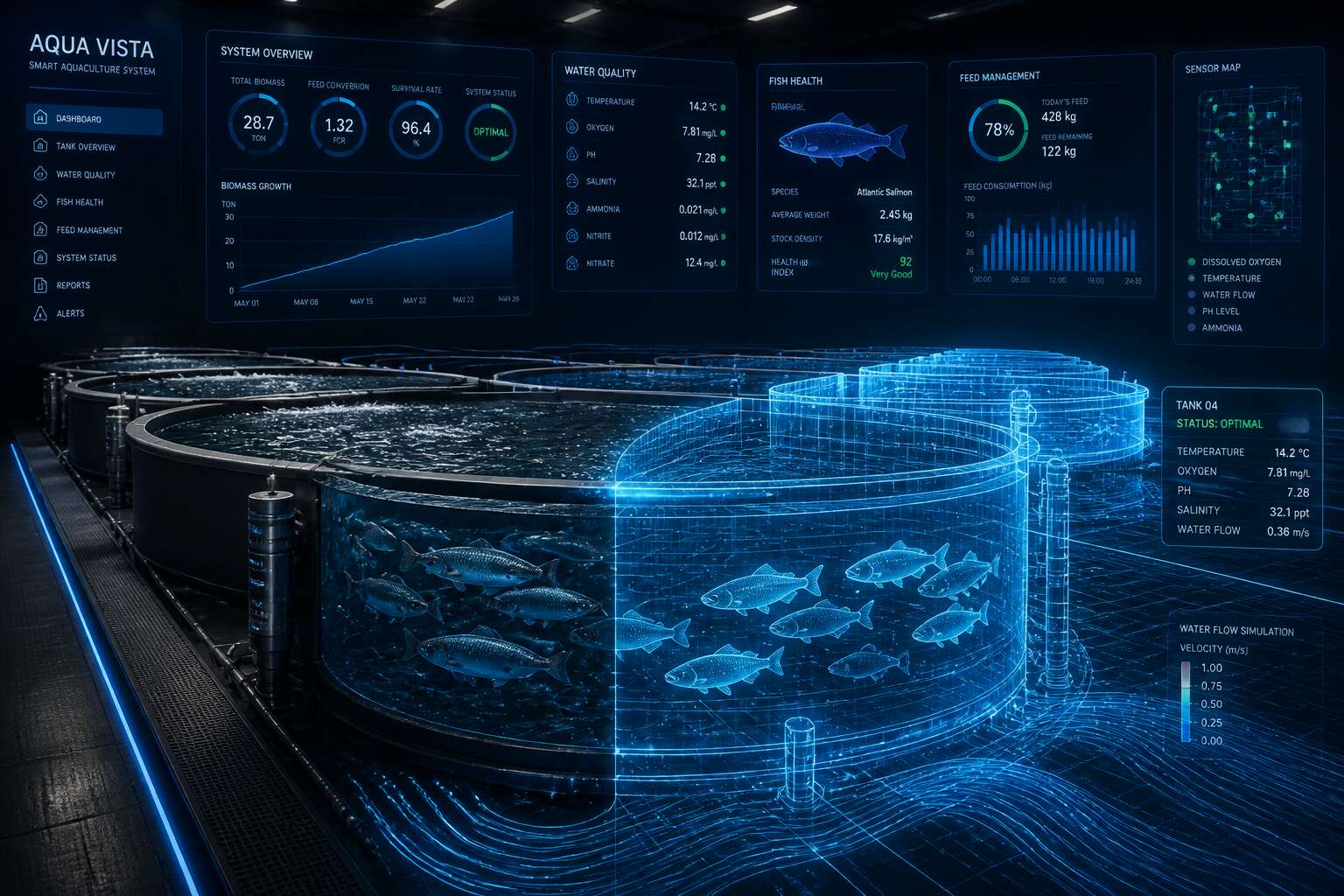
Precision fish farming changed that! Sensors track dissolved oxygen, temperature, and feed conversion around the clock. The data reveals patterns no human eye could catch, and it does so without fatigue. A modern control room surfaces critical information in a single morning:
- Oxygen depletion risk across high density pens
- Feed conversion anomalies tied to recent weather fronts
- Growth trajectory comparisons against regional benchmarks
Digital twin technology for aquaculture systems simulation takes this further. Operators can build a virtual replica of the entire farm, test stocking densities, simulate disease scenarios, and observe outcomes before a single fish is committed. That is the difference between hoping for a good season and engineering one.
The Rise of Real-Time Environmental Monitoring
The evolution of precision fish farming did not arrive through a single breakthrough. It emerged from thousands of small corrections, each one logged and compared. Real-time environmental monitoring now captures conditions that previously went unnoticed until they became crises.
Consider what a modern sensor array tracks across a South African coastal farm:
- Dissolved oxygen at multiple depths, updated every few minutes
- Salinity shifts after heavy rainfall or upwelling events
- Thermal stratification that can trap warmer water near the surface
These streams feed directly into digital twin technology for aquaculture systems simulation. The virtual replica absorbs live data and projects likely outcomes. It answers questions about stocking density and aeration schedules before a single fish is stressed. That is the edge that digital twin technology for aquaculture systems simulation provides. It turns raw environmental telemetry into a preview of the coming hours.
Why Virtual Replication Is Gaining Traction
Every physical trial in aquaculture carries a price measured in lost feed, stressed stock, and delayed decisions. Virtual replication removes that penalty. A farm manager can test aeration changes against historical conditions without touching the water!
The shift toward digital twin technology for aquaculture systems simulation reflects a deeper change in how producers perceive risk. Simulation allows failure in a controlled environment. It turns guesswork into repeatable experiments.
Why is this gaining traction now?
- Computational costs have fallen sharply
- Sensor data has reached sufficient resolution
- Predictive models have achieved operational fidelity
What stands out to me is how these forces converge in South African coastal operations, where variability is the norm.
Core Building Blocks of a Virtual Aquatic Ecosystem
Sensor Networks and IoT Infrastructure
Every virtual aquatic ecosystem begins with a single reading, a sensor suspended in the water. That datum, multiplied across thousands of nodes, forms the physical foundation for digital twin technology for aquaculture systems simulation. Without this layer, the virtual replica has nothing to mirror.
The sensor network captures dissolved oxygen, temperature, salinity, pH, and turbidity at regular intervals. These instruments relay raw signals through the IoT infrastructure connecting ponds, tanks, and offshore pens. The data flow is continuous, and in my experience, farms that recalibrate these sensors weekly see far fewer false alarms.
The typical deployment includes:
- Optical oxygen sensors that detect hypoxic events early.
- Acoustic telemetry to track fish behaviour and feeding activity.
- Current profilers to map water movement across the farm.
Edge gateways preprocess this telemetry, filtering noise before transmission to the cloud. The result is a consistent stream of operational truth for the simulation engine.
Hydrodynamic and Water Quality Modeling
The virtual ecosystem depends on accurate physics. Hydrodynamic modeling calculates how currents shift across a farm, how oxygen disperses from aeration units, and how warmer surface layers interact with denser water below. The simulation engine solves these equations continuously, adjusting for tides, wind, and pump placement.
Water quality modeling works in parallel. It tracks ammonia, nitrite, and dissolved oxygen as living variables. Waste accumulates, bacteria convert compounds, and the model predicts where problems will emerge before they become visible.
A typical model includes:
- Current velocity fields for every basin
- Temperature stratification profiles
- Oxygen consumption rates per biomass unit
- Nutrient loading from feed inputs
These layers give digital twin technology for aquaculture systems simulation its predictive weight. For coastal farms, this means anticipating upwelling events. For inland recirculation systems, it means balancing biofiltration against feed schedules. The result is a working model of the water itself.
Biological Growth and Feeding Algorithms
Growth in a virtual aquatic ecosystem is a calculation of metabolic cost. Biological growth models and feeding algorithms simulate how each cohort converts feed into biomass, adjusting for species-specific digestion rates, water temperature, and stress hormones. The core building blocks include:
- Daily feed ration distributed across tanks or cages
- Mortality projections based on historical stock data
- Feed conversion ratio adjustments per life stage
These parameters allow digital twin technology for aquaculture systems simulation to test feeding strategies before they touch the water. I find this particularly useful for South African farms facing seasonal temperature swings!
Machine Learning for Pattern Recognition
Machine learning gives a virtual aquatic ecosystem its predictive edge. Rather than relying on static rules, the system watches sensor feeds for recurring spatiotemporal patterns. It notices when dissolved oxygen drops at 3 a.m. on calm nights. It flags when feeding behaviour shifts three days before a low-pressure front arrives. These correlations become the core building blocks of the twin.
- Pattern recognition across temperature, pH, current velocity, and stock movement
- Anomaly detection for early signs of stress or equipment failure
- Forecast models trained on generations of historical farm data
Each interaction refines the model. The twin improves with every harvest, every season, every anomaly. This is why digital twin technology for aquaculture systems simulation depends on machine learning at its foundation. Without it, the twin would simply mirror the present. With it, the twin anticipates tomorrow.
Data Pipelines for Continuous Calibration
Data pipelines keep the twin honest. They ingest raw readings from every probe, scrub noise, align timestamps, and flag conflicts before the model consumes them. This is the quiet infrastructure behind digital twin technology for aquaculture systems simulation.
No pipeline survives without calibration. When a dissolved oxygen probe in a KwaZulu-Natal pond drifts from the virtual value, the gap gets logged and resolved. Sometimes the sensor needs recalibration; sometimes the model needs adjusting.
- Sensor drift patterns over time
- Model prediction errors against actual harvest data
- Seasonal corrections for water temperature variances
- Operator sign-off on every parameter change
The building blocks stay invisible when they work correctly. That is the point.
Practical Applications Across the Aquaculture Value Chain
Optimizing Feeding Regimes and Feed Conversion Ratios
Feed is the largest operational cost in aquaculture, often exceeding half of total expenditure. That reality presses directly on South African producers facing thin margins. A digital twin technology for aquaculture systems simulation allows operators to test feeding strategies before committing a single kilogram of feed to the water.
Within the twin, biological growth algorithms interact with live water quality data and historical feeding responses. The system identifies patterns human observation routinely misses, such as how a particular tank’s flow rate alters nutrient absorption during colder months. Feeding shifts from a scheduled routine to a precise, responsive act.
- Adjusting pellet size and delivery frequency based on simulated gut fullness
- Detecting feed waste before it degrades water quality
- Forecasting weight gain trajectories for individual cohorts
The result is a quieter, more deliberate approach to production, one where intuition still matters but no longer works alone.
Early Detection of Stress and Disease Outbreaks
A single undetected pathogen can close a South African hatchery within days. Most producers only notice when visible symptoms surface, and by then the infection has already moved through adjacent tanks. Digital twin technology for aquaculture systems simulation compresses that detection window from days to hours.
The twin cross-references gill movement patterns, appetite variability, and dissolved oxygen readings against baseline behavior. When deviations cluster, the system raises an early alert. I have watched farms lose tanks because warning signs stayed buried in logs.
- Identifying thermal stress before mortalities begin
- Tracking bacterial load spikes in recirculating systems
- Predicting disease spread through stocking density analysis
This matters across the value chain, from hatcheries to grow-out facilities. Producers receive actionable warnings while intervention remains affordable.
Scenario Testing for Infrastructure and Farm Design
A 6 million rand expansion in the Western Cape unravelled during the 2019 summer because the planned recirculating system could not handle heat spikes. Scenario testing with digital twin technology for aquaculture systems simulation would have exposed that flaw before concrete ever touched the ground.
Farm design is now testable in virtual space. I have seen producers reshape their entire layout around hydrodynamic behavior, placing, and then replacing, baffles and drum filters without touching a single pipe! The twin answers questions about flow dead zones, oxygen distribution, and structural load during storm surge conditions.
- Testing tank geometry against variable stocking densities
- Simulating pump failures during extended load shedding
- Comparing open flow versus recirculating farm layouts
This shifts infrastructure from guesswork to verification. Digital twin technology for aquaculture systems simulation lets a producer walk through a proposed facility before committing capital, and that is the difference between a farm that survives its first drought and one that does not.
Sustainability Reporting and Regulatory Compliance
Digital twin technology for aquaculture systems simulation now stretches beyond the farm gate. Hatcheries use it to forecast larval survival under varied water treatments. Processors simulate cold chain disruptions to meet export standards. Retailers assess shelf life through replicated environmental data. The twin ties each link to a single source of truth.
South African regulators are noticing. The twin generates auditable records of water usage, effluent quality, and chemical application. That data feeds directly into sustainability reporting frameworks. One producer I met used the twin to prove compliance with a Section 21 water use licence before an inspection. No binders, just live simulation.
- Generating discharge reports for coastal permits
- Modelling seasonal water demand for municipal allocations
- Verifying biosecurity protocols across a supply network
These tasks once took weeks. Now they are continuous outputs of the simulation ecosystem!
Addressing Implementation Challenges
Computational Load and Real-Time Processing Constraints
South Africa’s energy grid, strained by load shedding, makes real-time simulation difficult to sustain. Computational load demands careful architecture. In digital twin technology for aquaculture systems simulation, every hydrodynamic equation competes with feeding algorithms for clock cycles.
Farm operators rarely need millisecond precision, but they do need reliable synchronisation. Edge processing, where local gateways filter sensor noise before the twin sees it, reduces the burden. Model order reduction, a mathematical simplification, keeps the twin faithful without exceeding hardware limits. A practical hierarchy emerges:
– Prioritise critical alerts over continuous visualisation
– Batch non-urgent calibration loads overnight
– Reserve cloud rendering for scenario testing, not live feedback
Such separation preserves state during outages. For a South African farm, digital twin technology for aquaculture systems simulation must survive a two-hour blackout without losing state awareness. That is the true benchmark.
Data Quality, Sensor Reliability, and Standardization
Every digital twin is only as trustworthy as the data it consumes. In South African aquaculture, sensors face salt spray, algal fouling, and temperature swings that skew readings. A dissolved oxygen probe drifting by 0.5 mg/L can trigger false feeding adjustments. Trust erodes quickly.
Standardization remains elusive. Different farms deploy different hardware, and proprietary formats complicate cross-comparison. I have watched technicians reconcile conflicting records from adjacent farms, each convinced their readings were correct.
For digital twin technology for aquaculture systems simulation to gain traction, data governance must mature. Key challenges:
- Calibration drift from biofouling and seasonal temperature changes
- Inconsistent data formats across equipment vendors
- Limited staff training on sensor maintenance
Without a common framework for acceptable drift and reporting standards, the twin presents unreliable signals as authoritative truth.
Bridging the Gap Between Biology and Engineering Expertise
The gap between aquaculture biologists and systems engineers often determines whether a digital twin survives contact with reality. Biologists understand animal behaviour, but may distrust algorithmic outputs. Engineers build elegant models, yet miss the visceral cues of a stressed fish population. In South Africa, where operational conditions vary sharply across provinces, this divide becomes tangible.
Successful implementation requires a shared vocabulary. For example:
- Define biological thresholds in engineering terms.
- Translate sensor anomalies into husbandry actions.
- Co-design validation protocols using both growth data and model outputs.
Only then can digital twin technology for aquaculture systems simulation earn the trust of both sides.
Future Trends in Virtual Aquaculture Environments
Adaptive Simulations Powered by Reinforcement Learning
Reinforcement learning will make today’s digital twins look rigid and passive! Future systems will not wait for human intervention to correct their logic. Instead, every simulated harvest becomes a training event. The twin learns from its own failures, refining decision pathways before the next iteration runs. That marks a profound shift in farm planning.
Consider what this enables:
- Autonomous recalibration of feeding algorithms after simulated mortality events
- Self-improving responses to sudden thermocline shifts
- Continuous policy refinement for harvest timing based on biological and market signals
The practical payoff emerges when digital twin technology for aquaculture systems simulation evolves from passive replication into active decision support. I expect South African farms, operating across variable coastal conditions, to gain the most from simulations that refine themselves overnight.
Cloud-Native Platforms for Collaborative Modeling
The most valuable dataset for a South African farm may originate hundreds of kilometres away. Cloud-native platforms make this practical by linking individual simulations into a shared modelling environment. Digital twin technology for aquaculture systems simulation can now absorb growth patterns from Langebaan Lagoon while informing harvest decisions in Algoa Bay, with every parameter traceable to its source.
- Hatchery teams validate growth algorithms against production data from multiple sites
- Independent consultants contribute hydrodynamic refinements without disrupting live operations
- Regulatory bodies inspect compliance scenarios within the same virtual environment
This is a departure from isolated farm planning. Collaboration once meant exchanging spreadsheets after a harvest. Now it happens in real time, inside the simulation itself.
Interoperability Standards Across Farming Systems
Interoperability remains the industry’s most polite fiction. Every farm uses its own data conventions, and the translator has not yet been invented. Yet the future of digital twin technology for aquaculture systems simulation depends on standardised vocabularies that allow a grow-out system in Saldanha Bay to converse with a hatchery in Port Elizabeth without human intervention.
The emerging standards aim to establish shared definitions rather than uniformity. Water quality parameters, feed event logs, and biomass estimates all need consistent structures. Consider what interoperability enables:
- Cross-farm benchmarking without manual data reconciliation
- Regulatory audits that query live simulations instead of static reports
- Supply chain partners who share calibrated models rather than approximations
Farms adopting these standards early will see their digital twin technology for aquaculture systems simulation compound in value as each new producer connects. The standards themselves will shift as the industry learns what actually matters.
Digital Replicas for Entire Supply Chains
The next phase of virtual aquaculture environments is supply chain replication. Digital twin technology for aquaculture systems simulation is expanding beyond individual farms to cover the entire journey from hatchery to harbour.
Producers will interact with continuous models that span grow-out, harvest, processing, and distribution. A single simulated ecosystem will replace the disconnected spreadsheets that track inventory and logistics. Consider what full chain replication makes possible:
- Harvest timing optimised against real freight schedules
- Cold chain deviation alerts that precede product spoilage
- Demand forecasts that adjust production targets automatically
These integrated environments offer a complete view of the value chain before any physical action occurs. For South African exporters, digital twin technology for aquaculture systems simulation reduces uncertainty at every handover point. The fully replicated supply chain is no longer a concept; it is the direction we are heading.
Autonomous Decision-Making and Closed-Loop Control
Current digital twin technology for aquaculture systems simulation is reactive. It tells you what happened and why. The next phase is autonomous decision-making and closed-loop control, where the twin acts on its own findings. Imagine a virtual environment that spots a dropping oxygen level, adjusts the aeration schedule, and signals the physical system to execute the change, all before a human opens the monitoring app. That is where we are heading.
Closed-loop control means the simulation verifies every action it takes. If the real world response deviates from the predicted outcome, the twin recalibrates instantly. This removes the lag between insight and intervention, which is crucial when a feed event is about to go wrong. For South African farms, this directly cuts the number of 2 AM panic calls.
- Self-adjusting feeding regimes based on real-time growth curves
- Automated water quality corrections without supervisor approval
- Equipment maintenance triggers that prevent costly downtime
We will see digital twin technology for aquaculture systems simulation evolve from a forecasting tool into the operational brain of the farm. The twin will handle the repetitive, time sensitive decisions that currently drain attention, and leave the nuanced judgement calls to the people who know the water best.
Educational and Training Applications for Farm Operators
Training happens on the water, but it shouldn’t have to. A new operator in the Western Cape can learn the rhythms of a recirculating system inside a virtual environment, before touching a single valve. These virtual environments use digital twin technology for aquaculture systems simulation to replicate failures that would cost real money if they occurred live.
- A sudden power failure during a heatwave
- A biofilter crash that unfolds over hours
- An aggressive algal bloom that resists treatment
Each session records reaction speed and decision quality. I have watched operators freeze during simulated pump failures, and I prefer that to freezing on a real farm! The twin logs every choice. Digital twin technology for aquaculture systems simulation turns rare disasters into routine drills. South African farms can compress onboarding from months to weeks, while senior operators keep sharp on emergencies they may never face.

0 Comments