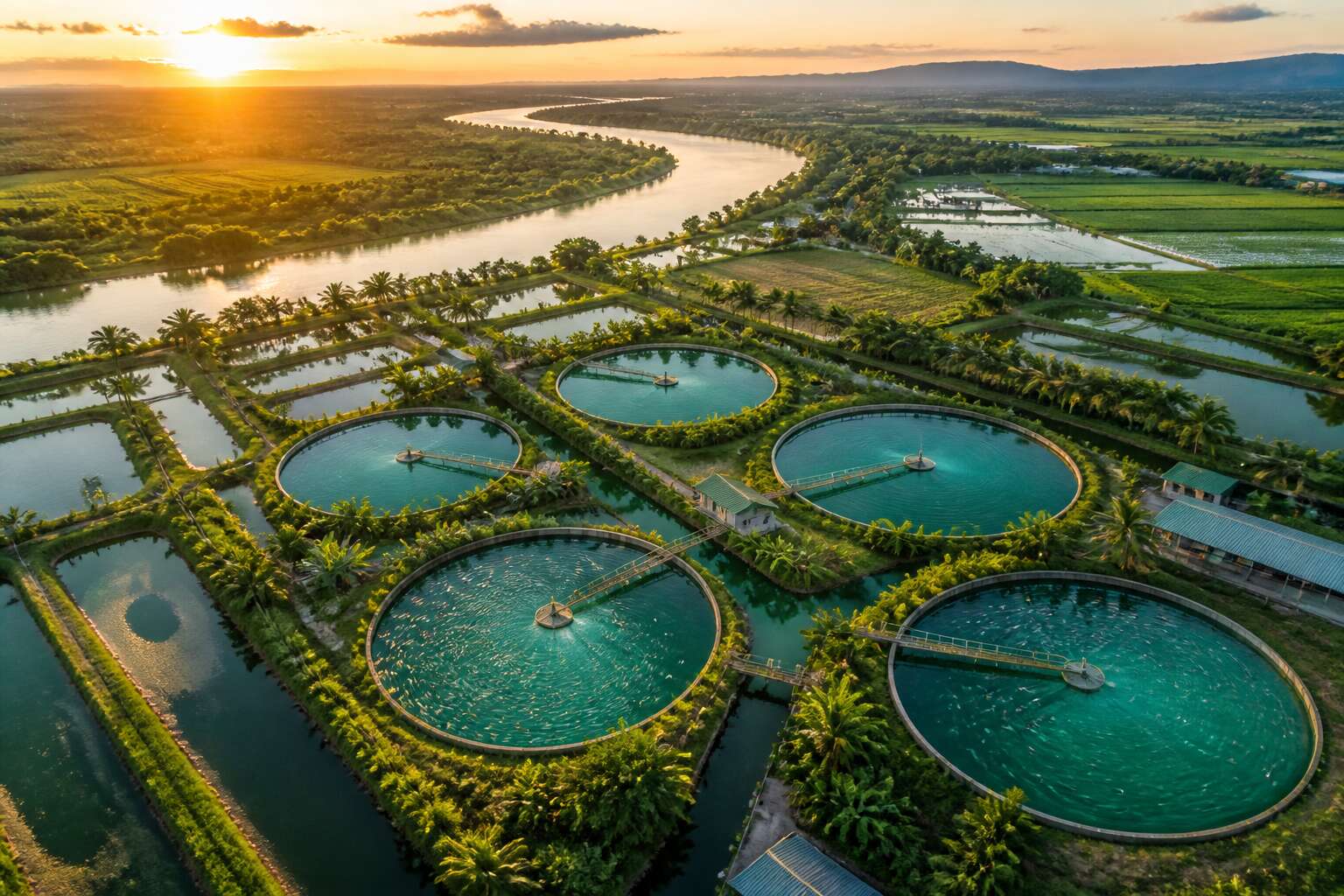
Understanding Water Dependencies in Aquaculture
Aquaculture consumes up to 1,000 liters of water per kilogram of fish, yet the real story lies in how water quality drives every outcome. I have watched farmers lose entire harvests because they failed to account for water turnover rates. The relationship between aquaculture and water resource management is not a luxury, it is survival.
Water dependencies in aquaculture are silent constraints. Oxygen levels shift with temperature. Ammonia builds when flow slows. Algae blooms follow nutrient spikes. Each factor demands constant attention, yet the margins for error are slim!
- Exchange rates determine dilution capacity.
- Depth influences thermal stratification.
- Currents affect waste removal.
These dependencies shape pond design, feeding schedules, and stocking densities. Without robust management, the system collapses. Aquaculture and water resource management must work in tandem, otherwise water becomes a liability, not an asset.
Water Quality Monitoring and Treatment Strategies
The pulse of a fish farm is its water, and in South Africa, that pulse beats under constant pressure. I have seen the quiet anxiety in an old farmer’s eyes on the Mpumalanga Highveld when the summer rains fail, knowing that his tilapia depend on a system he cannot fully control. For anyone involved in aquaculture and water resource management, the real work is not in feeding or harvesting, but in watching. It is about reading the clarity, the temperature, and the life within the water every single morning before the sun gets too high.
Monitoring is a guardian’s task, not a bureaucratic one. You track dissolved oxygen levels like you would track a sick child’s fever, and you adjust the aeration before the fish show signs of distress. The chemistry can turn on a dime after a heavy storm or a period of intense heat, so routine checks are non-negotiable. This is the groundwork for effective treatment, ensuring the pond stays resilient.
– Checking ammonia and nitrite levels to prevent silent toxicity.
– Observing algae blooms that starve the water of oxygen at night.
– Testing pH to prevent lethal fluctuations.
When the numbers shift, treatment becomes a craft. I prefer biological solutions, such as biofilters and specific bacterial amendments, which work with the ecosystem rather than against it. It is a delicate balance here, where water is a shared commodity with farms and towns. Proper treatment strategies in this landscape conserve that resource, ensuring a small operation can survive the month without drawing too heavily on the local supply. Every action you take echoes down the drain. It is a promise you make to the river and to the next generation of farmers.
Sustainable Farm Design and Water Efficiency
South Africa receives roughly 450 millimetres of rain annually, about half the global average. That scarcity shapes my approach to sustainable farm design. Water efficiency drives every layout decision.
Recirculating systems with sound hydrology can cut freshwater demand by 90 percent. I have watched farms waste this potential by ignoring simple principles. Sloped pond banks, planted buffers, and strategic windbreaks reduce evaporation and improve water quality.
- Runoff routed from rain events into storage ponds
- Aeration devices positioned to maximise mixing with minimal energy
- Inline sensors tracking conductivity to adjust flows
The result is a system where aquaculture and water resource management work in tandem. Farm design built on water efficiency creates resilience that ordinary layouts lack.
Waste Management and Effluent Control
I have watched South African farmers lose seasons to effluent gone wrong. Sludge accumulates silently, and by the time the water turns murky, the damage is done. The question in aquaculture is not whether waste exists, but where it settles.
Proper effluent control starts with solids removal. Settling ponds, mechanical filters, and biofloc systems all play a role. The overlooked factor is the sludge itself. It consumes dissolved oxygen as it decomposes. That process can destabilise the water column.
Consider the ways effluent builds up:
- Uneaten feed sinking below the water column
- Metabolic byproducts from high density stocking
- Phosphate release from anaerobic sediment layers
This is where aquaculture and water resource management intersect. Each kilogram of feed adds nitrogen and phosphorus. Without intervention, those nutrients become toxic. The balance depends on continuous monitoring and timely discharge.
That is the truth I keep returning to. Waste is inevitable. Failure is not.
Watershed Protection and Community Collaboration
In my years tracing the flows of our most vital resources, I have found that the true currency of conservation is trust. The health of our watersheds is not merely a technical puzzle, but a reflection of our collective character. For the aquaculture and water resource management sector, a watershed is a living system where every farm, town, and industry upstream leaves its mark in the water downstream. This interconnectedness is the fundamental moral challenge of our time.
We cannot build walls around our water security. The days of unilateral decision-making are over, and the communities that drink from the same source must now be the ones to protect it.
In South Africa, the pressures of drought and development have forced a reckoning. The collaboration that emerges from this pressure is powerful, yet fragile.
Specifically, active stewardship involves several key practices:
1. Establishing joint monitoring committees to track water quality rigorously.
2. Implementing shared remediation plans for riparian zones.
3. Aligning agricultural and municipal discharge standards to protect shared interests.
This is not always a smooth process. It requires a willingness to listen to conflicting perspectives and internalize the fact that our individual survival is tied to the collective whole. However, it is in this messy, human negotiation that the true value of aquaculture and water resource management is realized. We are not just farming fish or allocating volumes; we are negotiating a future where no one is left thirsting due to another’s gain.
Climate Resilience and Future Water Planning
By 2030, South Africa’s water demand could outstrip supply by 17%. That gap threatens every farm, processor, and hatchery. For those in aquaculture, the stakes feel personal. Your ponds and tanks depend on a resource that no longer behaves predictably!
Climate resilience means designing systems that withstand stress. It means rethinking how we capture, store, and allocate water. Aquaculture and water resource management must evolve together, not as separate disciplines. I have watched operations collapse because they treated water as an infinite input. The pressure points are now unmistakable:
- Prolonged drought cycles that shrink dam levels
- Flash floods that overload discharge systems
- Saline intrusion into coastal aquifers
Future water planning cannot rely on historical rainfall data. Past records fail under current conditions. Instead, we monitor groundwater recharge, evaporation rates, and effluent quality in real time. This is not bureaucracy. It is survival.

0 Comments