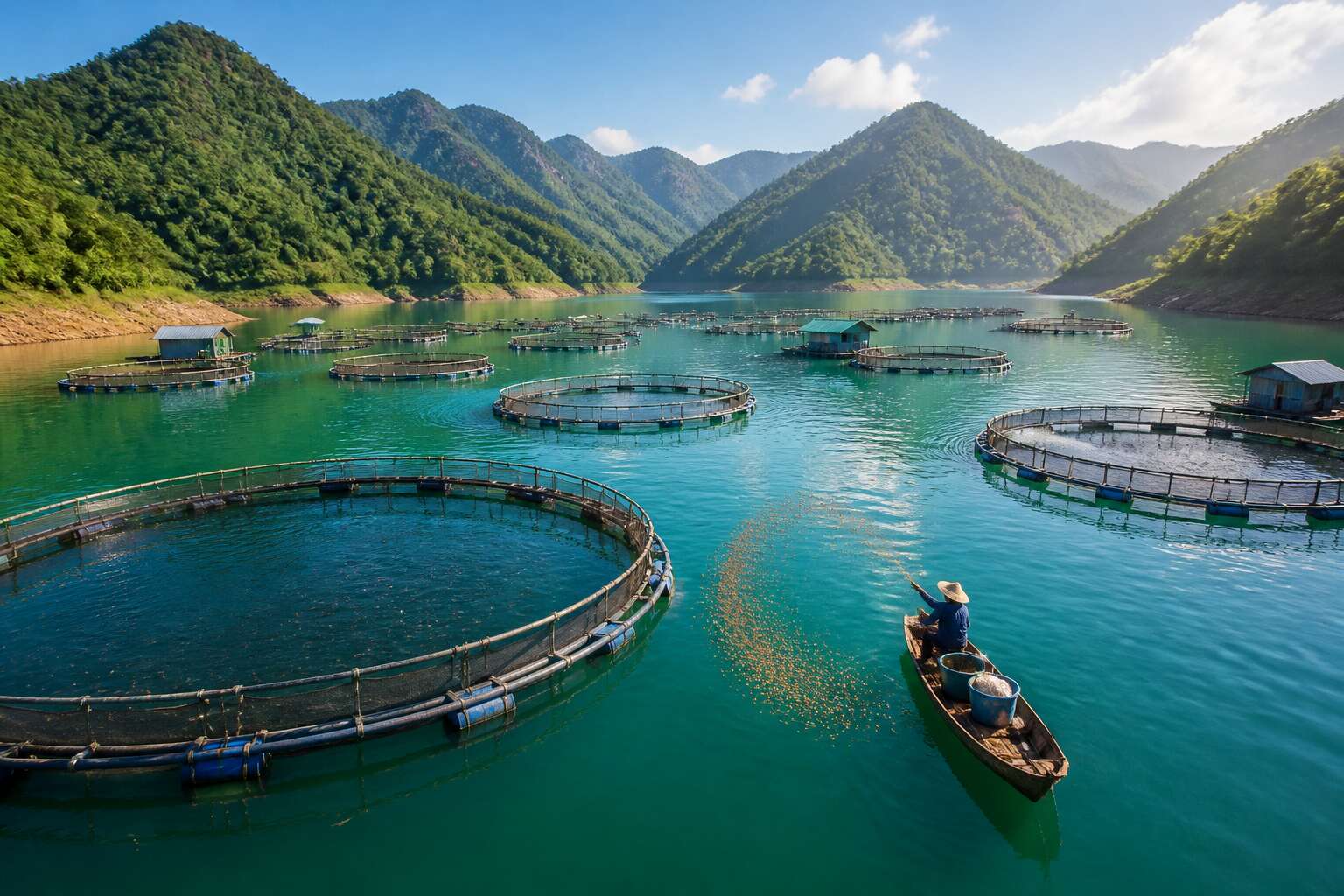
Overview of Aquaculture in Thailand
Thailand’s Position in Global Seafood Production
Thailand consistently ranks among the top ten aquaculture nations on Earth, with an annual output exceeding 1.5 million tonnes of farmed fish and crustaceans. That staggering volume flows into global supply chains, stocking supermarket freezers in Johannesburg, London, and Tokyo alike. I have watched Thai farmers pull nets heavy with barramundi, and the precision of their work is remarkable.
The industry thrives on a curious mix of ancient pond culture and modern hatchery science. Smallholder families still tend mangrove shrimp beds along the southern coast, while industrial operations run recirculating systems near Bangkok. This dual structure gives fish farm Thailand a resilience that many competitors lack.
What truly sets the kingdom apart is its export sophistication. Thai processors turn raw harvests into frozen fillets, smoked products, and ready to cook meals, capturing value at every stage.
Historical Development of Freshwater and Marine Fish Cultivation
The muddy origins of Thai aquaculture reach back centuries, long before the country became a shelf staple in Cape Town. Freshwater pond culture, particularly for species like climbing perch and snakehead, sustained small river communities who passed down techniques through generations. These early practices relied on observation and seasonal patterns, not complicated machinery. By the 1940s, government initiatives began promoting tilapia rearing, which broadened the appeal of farming fish as a reliable protein source.
Marine cultivation took a separate path, expanding seriously only after the 1970s, when coastal provinces embraced the commercial possibilities of brackish water species. This modern era introduced intensive breeding programs and feed innovations.
– Milkfish and sea bass production spread along the Gulf coast
– Hatchery technologies reduced juvenile mortality
– Frozen exports opened the Japanese and European markets
What started as a village food source evolved into a structured industry. The shift from subsistence to commercial scale did not erase tradition, it layered new science over old knowledge. Understanding this progression matters for anyone assessing the current capacity of a fish farm thailand operation today.
Economic Significance and Rural Employment Opportunities
Half a million rural households rely on aquaculture for income, a figure that explains the sector’s political weight. In villages along the Chao Phraya delta, a single fish farm thailand operation often supports three generations under one roof.
The economic significance extends beyond export ledgers. Feed mills and logistics firms employ thousands who never lift a net. Rural employment shifts as these farms need steady year round labor, unlike the monsoon dependent calendar of rice paddies. Cooperatives now negotiate collective pricing, chipping away at middleman dominance. Even modest fish farm thailand ventures cascade income through local suppliers.
- Smallholders control roughly 70% of freshwater output
- Processing hubs cluster near provincial capitals
- Youth return when mechanization raises wages
This cycle retains capital locally, curbing urban drift.
Key Geographic Regions for Aquaculture Operations
The Chao Phraya basin alone hosts hundreds of thousands of ponds. Each zone in Thailand, from that basin to the Korat Plateau and the Andaman coast, offers distinct conditions for a fish farm thailand operation, from floodplain ponds to brackish water estuaries.
The central region leads freshwater output, while the northeast depends on cage culture in reservoirs. Coastal provinces like Surat Thani and Songkhla handle marine species. Farmers choose systems based on hydrology and market access.
- Central plains: tilapia and catfish ponds
- North and northeast: cage culture in rivers and dams
- Southern peninsula: grouper and shrimp in tidal zones
Water rights and land tenure shape where ventures succeed. Some regions integrate rice and fish production, others run intensive monoculture. Temperature and rainfall set stocking calendars, creating a range of production cycles across the country.
Popular Fish Species Cultivated in Thai Waters
Freshwater Favorites: Tilapia, Catfish, and Snakehead
Walk past any earthen pond in central Thailand and you will likely see tilapia. This hardy fish thrives in the warm, shallow water that dominates the region. It grows quickly and tolerates mediocre water quality, making it a reliable staple. I have seen pens overflowing with Nile tilapia, their silver flanks flickering beneath the surface.
Catfish, the striped Pangasius, are another mainstay. Farmers raise them in dense numbers, often in concrete tanks. They convert feed efficiently, which matters when input costs climb. Then there is the predatory snakehead, a prized catch. It fetches higher prices!
- Tilapia: low maintenance, high yield
- Catfish: efficient feed conversion
- Snakehead: premium market value
Each species suits a different business model. A modest fish farm thailand might start with tilapia and graduate to snakehead once the farmer masters water management. The choice shapes everything from feeding to harvest. Many smallholders run precisely this kind of fish farm thailand.
Brackish Water Specialties: Seabass, Milkfish, and Grouper
Along the coasts where freshwater rivers meet the salt of the Gulf, another kind of farm begins. Brackish water aquaculture thrives in the intertidal zones of Samut Sakhon and Surat Thani. These transitional waters allow species that would fail in purely freshwater ponds. Asian seabass, or barramundi, school in floating cages, their bodies built for chasing baitfish. They grow rapidly in the warm, saline mix, and farmers monitor oxygen levels with a priest’s vigilance. Milkfish, with their delicate, bony flesh, prosper on a diet of filamentous algae. They turn ponds into green, shimmering fields. Grouper demand patience and clean water, but they reward the farmer with a premium price in export markets.
– Seabass: rapid growth in floating cages
– Milkfish: thrives on natural algae
– Grouper: high value, requires precise water conditions
The salinity must be measured and adjusted with each tide and rainfall. A fish farm thailand that masters this balance holds a distinct advantage. The same coastal plot can yield three different harvests, or cycle species as the seasons shift. For a smallholder, the risk is higher than with tilapia. But the payoff in Bangkok’s seafood markets is real. I walked a grouper farm once, and the owner showed me how he tests the water with his bare hand, tasting the salt on his fingers. That kind of knowledge cannot be automated. It is the quiet currency of the trade.
Emerging Marine Species with Commercial Viability
In Thailand, some marine species wait beyond the tidal flats, holding promise for those who dare to venture. The barramundi’s cousin, the cobia, patrols deeper waters with a fast metabolism. It converts feed into muscle at an impressive rate. Pompano offer a delicate texture that drives demand in upscale restaurants. The hybrid grouper, a cross of the tiger and giant grouper, matures faster than its parent stock. These species require significant capital for open ocean cages, a test of patience for any investor. The old aquaculture route of freshwater fish leads to different rewards. But for the experienced farmer, the shift offers a place in a select market.
The emerging frontier in a fish farm thailand involves high value species, which brings a new set of challenges.
– Cobia: Rapid growth, but needs strong currents and ample space.
– Pompano: Delicate flesh, a favorite in high end dining.
– Hybrid grouper: Faster growth, but with higher mortality risks.
I spoke with a farmer in Krabi who described the ocean as a jealous partner. It takes everything you give it. This isn’t about replacing the tilapia ponds. It is about a calculated risk. The market logic is simple: higher risk, higher return. For a smallholder with limited resources, it is a story of caution. The farmer’s own intuition, tested against the sea, remains the only reliable compass. The future for those who succeed lies in this deliberate, high stakes gamble.
Ornamental Fish Farming and Its Niche Market
Still, the true breadth of a fish farm thailand operation is seen in its diversity. Beyond the heavyweight commodities, farmers deliberately stock species that fill specific market gaps. Walking catfish remain a staple for local wet markets, where their hardiness translates to lower production costs. Pla Chon, or the snakehead, is another staple, though it demands a steady supply of live prey. These are the fish that feed a nation, not just the restaurants. They are the cornerstones of domestic food security, offering a predictable income stream with manageable risk levels.
– Walking catfish: Survives low oxygen levels; perfect for high density ponds.
– Pla Chon (Snakehead): A regional favorite, but a carnivorous appetite.
– Silver barb: Thrives on a vegetable diet, bringing down feed expenses.
But then there is the ornamental sector. It is a world apart from the commercial food chains. I once visited a breeding facility outside Bangkok where the water was crystal clear, and the fish were valued in dollars per inch, not per kilogram. This is the niche market of designer fish. The Siamese fighting fish, the Betta splendens, is a national icon. Breeders select for extreme finnage and color patterns, creating living canvases.
The global demand for these fish is immense. Exporting them requires logistics, oxygen packed bags, and delicate handling. A single shipment can hold thousands of fry, each one a tiny investment. The profit margins here are not about volume; they are about aesthetics. This side of a fish farm thailand operation is less about farming and more about curation. The technology involved, from automated water filtration to precise pH monitoring, is cutting edge. It is a hidden world within the industry, one that rewards a keen eye for detail and an understanding of international tastes. It transforms the job from a fisherman into a breeder of living jewels.
Native vs. Exotic Species and Their Impact
Thailand’s aquaculture success often hinges on a pragmatic choice between native resilience and exotic efficiency. Local species like the Siamese gourami and the climbing perch have adapted to the region’s climate over centuries, making them less susceptible to local diseases. Exotic imports, such as the Nile tilapia and pangasius, were introduced for their rapid growth rates and high feed conversion ratios. These traits have made them commercial powerhouses within the fish farm thailand sector.
However, the introduction of fast-growing exotics carries ecological weight. They can outcompete native fish for resources if they escape into open waterways. A responsible fish farm thailand operation now actively manages this balance. Farmers often rely on sterile stocking or stringent containment protocols to prevent genetic pollution. The choice is not merely agricultural; it is an environmental calculation.
I have seen operations where the focus is solely on the local market’s palate. They favor the traditional flavors of native carp. Others prioritize global export demands, which favor the predictable yields of exotic species.
– Native species offer genetic purity and cultural culinary value.
– Exotics provide production efficiency and higher yield per hectare.
The economic reality is that both native and exotic species have a place in the industry. The true measure of sustainability lies in how these fish are managed, not just in their origin. The most enduring farms treat this as a matter of ecological stewardship.
Fish Farming Systems and Modern Techniques
Pond-Based Culture: The Traditional Backbone
The typical image of a fish farm thailand often involves vast, earthen ponds stretching under the tropical sun. While this picture holds true, the reality of modern pond culture has evolved into a sophisticated operation. These ponds are no longer simple holes in the ground; they are engineered ecosystems designed for maximum yield and disease control. You will find that the integration of technology is what separates a thriving operation from a struggling one.
Modern techniques focus on water quality management, which is the linchpin of successful aquaculture. Farmers now utilise paddlewheel aerators to maintain oxygen levels and probiotics to manage the microbial balance. This shift towards biological management reduces the reliance on chemicals. For the South African reader looking to understand global practices, the Thai approach offers a clear lesson in resource efficiency. The investment in these systems is substantial, but the return on investment is visible in the survival rates and growth of the stock.
The industry has also moved towards a more intensive, data-driven model. Sensors can now monitor pH, temperature, and ammonia levels in real time, sending alerts directly to a farmer’s smartphone. This allows for immediate intervention, preventing catastrophic losses. The shift is particularly evident in the transition from traditional monoculture to more resilient polyculture systems, where different species are raised together to utilise all levels of the pond. Common practices include:
– Stocking tilapia at the surface to feed on prepared feed.
– Introducing catfish at the bottom to consume leftover waste.
– Using the water column for a secondary crop like freshwater prawns.
These methods maximise the use of available space and resources without the need for extra land. It is a pragmatic response to the high cost of feed and the pressure on land use. For anyone analysing the operational side of a fish farm thailand, the emphasis is clearly on biological control and mechanical efficiency. The old ways are gone, replaced by a precision approach that mirrors terrestrial livestock farming.
Recirculating Aquaculture Systems (RAS) for High-Density Production
Recirculating Aquaculture Systems, known as RAS, flip the old pond model on its head. Inside climate controlled warehouses, a fish farm thailand can produce tonnes of protein in a space no bigger than a suburban garage. Water cycles through filtration tanks, biological reactors, and UV sterilizers, losing less than 10% to evaporation. The system purges ammonia continuously, so fish grow faster and disease spreads slower.
The trick is energy. Pumps and oxygenators draw serious power, and that cost filters straight into the price per kilogram. For Thailand, where land near water commands a premium, RAS makes economic sense. It also sidesteps monsoon floods and drought.
Some operators stack tanks vertically to boost density further, pulling two harvests a year where ponds manage one.
Integrated Rice-Fish Farming and Agro-Ecological Benefits
Rice paddies in Thailand’s lowlands are becoming dual ecosystems. Farmers dig brood channels around the paddy perimeter, then flood fields after transplanting. Fingerlings eat golden apple snail eggs and weed seedlings, trimming pesticide costs while aerating the root zone.
This fish farm thailand approach, called integrated rice-fish culture, runs on a closed nutrient loop. Fish waste feeds algae, algae feed zooplankton, zooplankton feed the fish. A well-managed fish farm thailand can pull two crop cycles per year without fallowing the soil.
The agro-ecological gains extend beyond the harvest. Paddy water recharges local aquifers. Duckweed carpets curb evaporation. Farmers see fewer total crop failures and steadier monthly income.
Hatchery and Nursery Management for Consistent Stock
Hatchery standards in Thailand now determine whether a fish farm thailand operation survives its first year. Healthy fingerlings, not luck, drive the success of modern grow out phases. Operators who control spawning conditions and feed protocols from day one see far more predictable harvests.
Nursery management has shifted toward measurable benchmarks. Water temperature, ammonia levels, and stocking density are checked daily in leading operations. This kind of discipline minimizes early mortality, which historically wiped out entire batches and left farmers with empty ponds and thin wallets.
– Genetic selection of broodstock to improve growth rates
– Biosecurity protocols to limit viral and bacterial outbreaks
– Formulated microdiets that replace live feed dependence
– Grading systems to separate size cohorts before pond stocking
These techniques require capital, but they pay off in consistency. A fish farm thailand that invests in proper larval rearing can time market entry precisely. That timing matters when prices swing across domestic and export channels. Consistent stock also simplifies feed budgeting and reduces the risk of cannibalism in juvenile populations. The result is a more stable operation that attracts long term buyers rather than one off traders.
Innovative Feed and Nutrition Strategies to Optimize Growth
As the sun cracks the horizon over earthen ponds, the quiet hum of aerators signals the shift. The days of simple throw-and-pray feeding are gone. Across Southeast Asia, the most resilient operations are rebuilding their foundations around controlled environments and precise nutrition. In this space, the role of a fish farm thailand operation hinges on its ability to adopt modern systems that do not rely on natural water bodies alone.
Protected cultivation methods are changing the landscape. Semi-closed systems allow for higher stocking rates, but they demand rigorous monitoring of oxygen and waste. For those chasing volume without losing consistency, the shift towards mechanical filtration and biofloc technology offers a path that reduces water exchange while maintaining a stable microbial community. This is not about building a fortress against nature, but about negotiating the terms of the harvest.
Feed remains the largest variable cost, and the silence of the balance sheet is where most ventures fail. Optimising growth means moving beyond crude protein percentages. The modern approach involves understanding the metabolic pathways of the stock, utilising additives that enhance gut health and nutrient absorption. Enzyme supplementation and the precise balancing of amino acids are no longer experimental. These strategies directly affect feed conversion ratios and reduce the burden on the water column, which is the silent partner in every transaction.
- Adjusting feeding frequency based on photoperiod and water temperature to maximise assimilation
- Integrating alternative proteins such as insect meal to offset soaring fishmeal costs
- Utilising slow-sinking extruded pellets to minimise loss and waste on the pond floor
The tangible outcome of these modern techniques is a sharper competitive edge in the export market. When a fish farm thailand operator manages to shave days off the growth cycle while limiting disease pressure, the ripple effect is felt across the supply chain, from pricing power to buyer confidence.
Regulatory Framework, Sustainability, and Environmental Stewardship
Government Policies, Licensing, and Compliance Requirements
The regulatory landscape for a fish farm thailand operation is evolving rapidly, and it is far more intricate than simply securing a plot of land near water. The Thai Department of Fisheries requires operators to obtain a specific aquaculture license, which is contingent upon environmental impact assessments for larger facilities. This licensing process ensures that production growth does not come at the expense of the country’s waterways.
Sustainability is now a central pillar of the national strategy, pushing farmers toward practices that reduce chemical runoff and preserve biodiversity. The government has introduced strict effluent standards for aquaculture operations, requiring farmers to manage water quality through settling ponds or treatment systems. To run a compliant operation, you generally need to secure:
- Proof of land tenure or a lease agreement with the Department of Lands.
- An aquaculture registration certificate from the provincial fisheries office.
- Compliance with the Hazard Analysis and Critical Control Points (HACCP) guidelines if you process the fish on site.
Environmental stewardship is a practical necessity here, not just a marketing term. Many local operators are now mandated to use feed conversion ratios that minimize waste, and they must maintain meticulous records to prove their adherence to these quotas. I have seen how this regulatory friction often forces smallholders to innovate, but it also protects the shared ecosystem that the entire industry relies on.
Environmental Impact Mitigation and Waste Management
Water quality determines the success of every fish farm thailand operation. Effluent must be treated before it returns to shared canals. Settling ponds and constructed wetlands convert waste into fertilizer.
Waste management begins with feed. Precise feeding schedules reduce excess nutrients that fuel algal blooms. Sludge collection techniques capture solids before they decompose. These methods lower biochemical oxygen demand and keep oxygen stable for wild fish.
Environmental stewardship means protecting surrounding habitats. Mangrove buffers filter runoff while providing nursery grounds. Some operations rotate pond use, allowing sediments to dry and mineralize.
Consider what Thai farms do:
- Regular water quality testing for ammonia and nitrite
- Sediment removal after each harvest cycle
- Bioremediation using beneficial bacteria
- Zero water exchange systems that recycle effluent
I have seen these practices secure the long term health of shared waterways. A fish farm thailand managing waste responsibly preserves the ecological balance on which future harvests depend.
Sustainable Certifications and Organic Aquaculture Standards
In the global marketplace, certifications are the currency of trust, and nowhere is this more tangible than in the verification of sustainable practices. For a fish farm thailand operation, third party audits are not administrative burdens; they are passports to premium markets in Europe and North America. These ecological credentials hinge on verifiable data. Traceability platforms now log every pellet of feed and every water parameter, creating a digital provenance that follows the harvest from pond to plate. The scrutiny is relentless because the commercial margins for certified stock outperform conventional yields.
Thailand’s regulatory matrix requires growers to reconcile national production quotas with international ecological benchmarks. This dual compliance filters out operators who lack the capital for rigorous water treatment infrastructure. Simultaneously, the push toward organic aquaculture standards prohibits synthetic chemicals and forces a return to polyculture models. A fish farm thailand that navigates these requirements often becomes a model for regional best practice, though the learning curve is steep.
The tangible benefits of this ecological alignment are evident in operational resilience. Consider the certification audit trail that governs daily tasks:
1. Documentation of antibiotic withdrawal periods and veterinary interventions.
2. Verification of feed ingredient sourcing and their ecological footprint.
3. Proof of biosecurity protocols that prevent cross contamination with wild stocks.
4. Continuous monitoring of dissolved oxygen and temperature data logs.
These measures reduce mortality rates and decrease the reliance on costly chemical interventions. The investment in compliance pays dividends through lower insurance premiums and stable access to export markets. While the initial cost of certification can seem prohibitive for smallholders, cooperative structures allow shared access to auditing resources. Ultimately, the fish farm thailand that embeds sustainability into its legal and operational DNA cultivates a reputation that no amount of marketing can fabricate, securing its longevity in a competitive arena.
Market Dynamics, Export Opportunities, and Future Outlook
Domestic Demand and Consumer Preferences
Here’s the thing about the Thai aquaculture industry: it has become a masterclass in bifurcation. Domestic demand remains a relentless beast, driven by a population that expects affordable protein with every meal. While middle-class consumers in Bangkok are increasingly gravitating toward premium and convenient seafood products, the broader market still revolves around the hardy trio of tilapia, catfish, and snakehead. The domestic price for these staples fluctuates like a moody teenager, heavily influenced by feed costs and the monsoon season. However, the real shakeup is happening in the cold chain logistics, which now allows fresh fish to travel from the farm gate to an urban supermarket within 24 hours.
Meanwhile, export opportunities have shifted from a simple volume game to a battle for added value. The global market is no longer satisfied with frozen whole fish; they want fillets, ready-to-cook meals, and exotic cuts. For a fish farm in Thailand, this represents a significant fork in the road. You either scale up for the commodity market or specialized niche. The savvy operators are capitalizing on the premium segment, particularly for species like plah nin and freshwater prawns, which command high prices in the United States and Europe. The demand for traceability is also rewriting the rulebook, as international buyers want to know the pedigree of their dinner.
Looking at the future outlook, domestic consumption shows no signs of slowing down. But the preference is definitely leaning toward value-added products that offer convenience, such as marinated portions or ready-to-grill packs. The challenge for local farmers is navigating the rising cost of fingerlings. There is also a growing consumer consciousness regarding antibiotic use, which is forcing many farms to adopt stricter biosecurity measures. The market dynamics in this sector are becoming less about who can produce the most, and more about who can produce the best with the least footprint. It is a compelling shift that will likely reward the adaptable and punish the stagnant.
International Export Destinations and Trade Trends
Thailand’s aquaculture sector is no longer a straightforward volume business, and the market dynamics are proving that point every day. The profit margin for a basic commodity fish has thinned out, while the demand for specialty products is growing. I have watched the buying patterns shift, and the buyers are becoming pickier about the origin and quality of their seafood. This is pushing many operators to reconsider their entire production model.
Export opportunities are increasingly defined by the ability to process and add value before the product ever leaves the dock. A fish farm thailand operator who is willing to invest in filleting lines and cold storage can access markets that simply are not available to those selling live fish at the local pier. The trade trends are clear, and they revolve around a few key points:
– The United States and Europe are the primary targets for premium fillets and ready to cook items.
– Traceability documentation is no longer a bonus, it is a baseline requirement.
– Freshwater prawns and high grade tilapia commands a significant price premium overseas.
– The domestic market still absorbs the bulk of the catch, but it offers lower margins.
Looking ahead, the future outlook for a fish farm thailand operation hinges on adaptability and biosecurity. The farmers who are investing in better water management and genetic stock will be the ones who survive the tighter regulations. I believe the days of the simple pond with no oversight are coming to an end. Those who are willing to modernize will find that the extra effort pays off in a more stable and resilient business, even when the global market price for feed goes through the roof.
Value-Added Products and Post-Harvest Processing
A fish farm thailand operation that sells whole fish to a local trader is leaving money on the table. The market dynamics have shifted, and the margins now live in the processing stage. Buyers want fillets, portion cuts, and ready to cook packs, not just live fish. A farm that invests in simple filleting lines and cold storage can capture a price that is two or three times higher than the raw commodity rate.
The export opportunities are strongest for operators who control the post harvest chain. A few practical value added products include:
– Vacuum packed tilapia fillets for European retail.
– Smoked or marinated catfish portions for regional supermarkets.
– Frozen seabass portions with clear traceability labels.
The future outlook for fish farm thailand depends on this kind of investment. Those who ignore post harvest processing will face shrinking margins and limited market access. The farms that adapt will hold a stronger position, even when feed prices spike or regulations tighten.
Digital Marketing and E-Commerce Channels for Direct Sales
Market dynamics for a fish farm thailand operation have shifted toward direct engagement. Wholesale middlemen once controlled pricing, but digital storefronts now let producers set their own terms. I have watched small farms build customer bases through simple social media catalogs and WhatsApp ordering. The margins are better, and the relationship is closer!
Export opportunities also emerge through e-commerce platforms that connect regional buyers with verified producers. A fish farm thailand can display harvest records, processing dates, and cold chain data on a product page. That transparency matters for overseas clients who cannot visit the farm.
- Live fish sales via scheduled delivery slots.
- Frozen fillet bundles with subscription options.
- Smoked portions for niche food importers.
The future outlook points to farms building their own logistics networks. Digital marketing removes the gatekeepers, and those who master it will hold pricing power when feed costs climb.

0 Comments