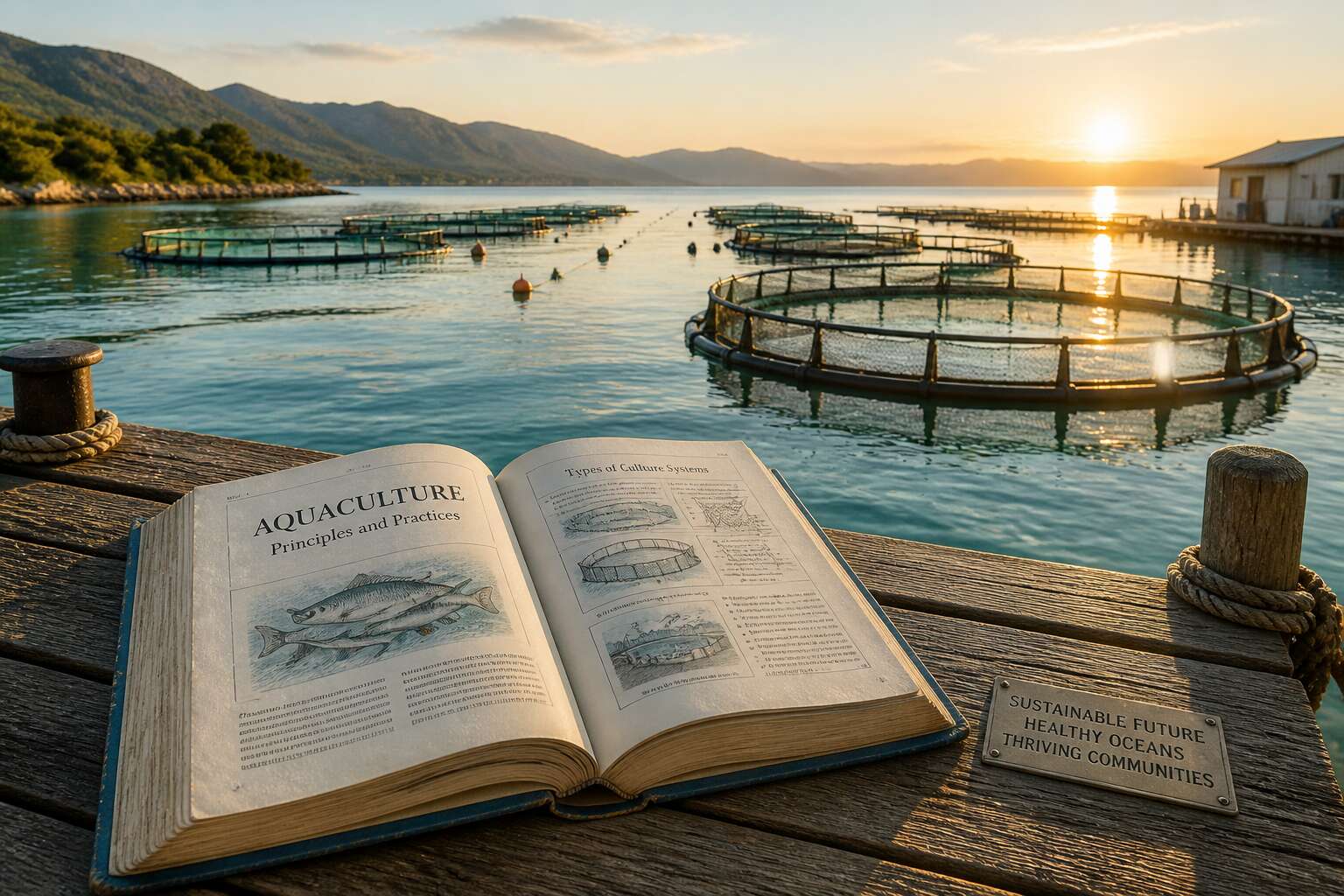
Why Invest in Professional Aquaculture Resources
Staying Current with Industry Trends
South Africa’s aquaculture sector is expanding faster than many investors realise! Putting money into a professional aquaculture book is a straightforward way to stay ahead of the curve. These resources condense technical research into usable guidance, reducing guesswork on the farm or in the boardroom.
Staying current with industry trends is not a passive activity. It requires seeking out new information before it becomes common knowledge. I regularly see operators fall behind because they settle for fragmented online posts. A structured reference helps you identify what matters now.
Track shifting areas:
- biosecurity protocols
- water quality monitoring
- feed conversion ratios
- regulatory updates
Monitoring these through professional channels keeps your decisions grounded.
Building a Solid Foundation in Aquatic Farming
The most accomplished aquaculturists I know carry a quiet reverence for foundational knowledge. They understand that a submerged pump failure or a sudden temperature shift reveals gaps in understanding. A focused aquaculture book distills decades of field observations into coherent principles, sparing you those harsh tutorials.
Building a solid foundation involves learning components like:
- optimal stocking densities for local species
- microbial community management
- stress response and immune resilience
These elements interconnect in ways that rapid online searches rarely explain. When I consult a professional reference, I notice how each chapter builds upon the next, creating mental scaffolding. That is the true return on your investment. It transforms fragmented facts into an integrated worldview for aquatic farming.
Enhancing Practical Skills and Troubleshooting
In the Karoo, a single failed aeration system can cost a farmer an entire season’s production. That reality drives many South African operators to keep a professional aquaculture book within arm’s reach of their control panels. These volumes earn their keep as diagnostic companions.
A professional aquaculture book maps failure modes. It explains how to differentiate between a bacterial outbreak and a nutritional deficiency. It documents electrical loads, pump curves, and oxygen transfer rates. When something goes wrong at 2 a.m., I trust structured diagnostic sequences over scattered online threads. Systematic troubleshooting determines whether you save the stock or lose it.
Consider what practical knowledge these references deliver:
- Reading water chemistry signals before they become catastrophic
- Calculating emergency backup requirements for filtration systems
- Recognizing early stress behaviors in local species
Nobody plans for equipment failure. But every experienced aquaculturist knows the distinction between theory and application becomes visible in a crisis. The right aquaculture book narrows that gap.
Supporting Research and Innovation
South African aquaculture’s growth depends on documented research, not guesswork. Fisheries scientists publish findings in journals, but farmers rarely access those pages. A professional aquaculture book translates this research into practical terms. It connects the laboratory to the farm, offering methods tested under local water conditions.
Innovation requires background knowledge. An aquaculture book with strong research foundations helps farmers experiment with recirculating systems or alternative feed formulations without starting from scratch. Several Karoo operators I know use these resources to refine their own production data. That feedback loop pushes the sector forward!
Professional resources also shape the next generation of researchers. Students and farm managers who study these texts ask sharper questions about water quality, genetics, and disease resistance. The better the reference materials, the more grounded the innovations.
Key Categories of Aquatic Farming Literature
Species-Specific Handbooks
Roughly 600 aquatic species are farmed globally, yet each demands its own set of husbandry rules. A single aquaculture book rarely covers them all. Instead, serious farmers turn to species specific handbooks.
These volumes drill into the nuances of a single organism. Consider abalone, whose slow growth and specific algae requirements confound beginners. A dedicated handbook explains water flow, feed conversion, and harvest timing. For tilapia, the focus shifts to breeding ratios and disease resistance. Each text becomes a field manual for that animal.
Handbooks typically include:
- Stocking density calculations
- Nutritional tables for each growth stage
- Common pathogen profiles
- Water quality parameters
These details come from years of trial and error. When you buy an aquaculture book, verify it targets your exact species. A general overview wastes time. Species specific guidance saves your stock and your budget.
Water Quality and System Management Guides
Water quality guides form the foundation of any aquaculture book collection. They explain chemistry in practical terms. A single misstep with ammonia or dissolved oxygen can undo months of effort. These texts cover filtration, aeration, and water exchange. They also explore system designs like raceways, ponds, and recirculating aquaculture systems. For South African farmers dealing with variable climates, such knowledge is critical.
Key topics include:
- Water testing protocols
- Biofilter management
- Oxygen demand calculations
- Emergency response procedures
I’ve often seen operators rely on intuition instead of data. That approach costs lives. A dedicated guide turns guesswork into a predictable routine. It helps you evaluate system upgrades without falling for equipment hype. When water is stable, animals thrive!
Nutrition and Feeding Manuals
Feed is the silent expense in aquaculture, often consuming over half of your operational budget. Nutrition manuals address this reality with practical precision. They translate the complex biochemistry of growth into clear, actionable feeding strategies. A good aquaculture book in this category will explain the differences between protein sources, lipid profiles, and vitamin requirements for various life stages.
Feeding schedules are more than routine. They are the primary lever you control for both growth and water quality. Overfeeding leads directly to deteriorating conditions. Underfeeding stunts development and invites health problems. These manuals typically cover:
– Feed formulation principles
– Feeding frequency and ration size
– Larval and juvenile nutritional needs
– Ingredient quality and sourcing
I have always found the sections on feed conversion ratios to be the most valuable. South African farmers, facing fluctuating ingredient costs, need to know the exact cost per kilogram of fish produced. This data, found within a focused aquaculture book, empowers negotiation and smarter purchasing decisions. It also prevents the common mistake of switching to cheaper, lower quality feed without adjusting the feeding plan. The knowledge transforms basic feeding from guessing into a precise, profitable science.
Disease Control and Biosecurity References
Catch a disease outbreak early, it costs you a harvest. Catch it too late, it costs you the farm and potentially your neighbours’ operations. That is the stark reality in South African aquaculture, where a single pathogen can alter the course of an entire season. A dedicated aquaculture book on disease control provides the foresight to turn chaos into a manageable procedure.
These references serve as your first line of defence. They translate clinical symptoms into visual guides and offer diagnostic protocols for species found in local waters. Instead of relying on reactive treatments, you learn to inspect the subtle signs of stress before they escalate. The best manuals focus heavily on biosecurity, offering checklists for practical concerns:
– Sanitation protocols for equipment and vehicles
– Quarantine durations for new stock
– Water source and effluent management
– Mortality removal and disposal strategies
– Record keeping for health inspections
Crucial knowledge also lies in understanding prophylaxis. Vaccination schedules, immune system support through nutrition, and the careful use of treatments that suit your specific water temperatures are all addressed. By consulting a comprehensive aquaculture book, you build a barrier against the invisible threats that roam the water column. It makes your investment resilient and your response to any health crisis decisive, safeguarding the ecosystem within your ponds.
Business and Marketing Books
Many farmers underestimate the commercial side of aquaculture. I have seen operations with excellent water quality fail because they lacked market insight. A solid aquaculture book can close that gap. These business titles cover pricing, distribution, and customer relationships.
They also address financial modelling and risk assessment. Some include case studies from South African farms. Consider these practical categories:
- Market analysis and value chain positioning
- Budgeting and cash flow management
- Branding and direct sales approaches
That one reference helps you move from producer to business owner. It turns harvests into sustainable profits.
How to Choose the Right Reference for Your Needs
Assessing Your Experience Level
Choosing the right aquaculture book begins with a clear-eyed look at your own footing. The seasoned operator and the curious newcomer need different kinds of guidance, and mixing them up leads to frustration. A practical starting point is to count your hands on experience in hours, not years, because that measure exposes the gap between theory and what you have actually touched.
Some readers thrive on deep water chemistry, while others need the rhythm of daily feeding routines. Begin by listing what you truly know, then what you cannot yet do well.
- Jot down every task you have completed alone, from water testing to harvesting.
- Next, mark the moments when you felt lost or had to improvise.
- Finally, flip through the reference’s index and see if those problem areas receive clear coverage.
That process reveals whether a particular aquaculture book speaks to your level or simply repeats familiar ground. Pick one that challenges without overwhelming, and your learning path will feel less like guesswork and more like discovery.
Identifying Your Production Goals
Your production goals define which aquaculture book will actually serve you. A farmer raising tilapia for local markets needs different guidance than someone culturing abalone for export. Before spending a cent, write down your target species, water system, and scale. That clarity narrows thousands of pages to a handful of useful ones.
I have seen operators buy a comprehensive marine handbook when their freshwater pond operation required simple feeding charts. The mismatch wasted months. Here is a practical checklist:
- List your annual production volume in kilograms.
- Identify your bottleneck, whether it is fry survival or growout density.
- State your water source and climate constraints.
Once you have those answers, search for an aquaculture book that addresses each constraint directly. The right reference matches your operation’s reality, not its promise.
Checking Author Credentials and Scientific Accuracy
A single erroneous dosage table or outdated biosecurity protocol can cost far more than the price of any aquaculture book. Credentials are the first filter. A marine biologist with twenty years of hatchery experience offers a different perspective than a journalist compiling secondary sources. Look for authors affiliated with recognised research institutions or with a documented history of managing commercial operations. The publisher also matters; university presses and established industry bodies typically enforce rigorous review processes.
Scrutinise the bibliography. A reference list dominated by decade-old citations suggests the content may not reflect current pathogen profiles or treatment efficacy. For South African operators, verify that the water chemistry examples and species data align with local conditions, not just temperate northern hemisphere models. The most reliable aquaculture book will openly discuss its limitations and data sources, allowing you to judge its applicability to your specific system.
Evaluating Practical Case Studies
Selecting the right reference requires examining how the author handles practical case studies. The most useful aquaculture book presents failures alongside successes, showing how operators adjusted stocking densities or adapted aeration systems under South African conditions. Case studies must reflect local species such as dusky kob or abalone, with water chemistry data from coastal or inland systems.
Evaluate whether the case studies include specific figures for feed conversion ratios, oxygen consumption, and mortality events. A case study that only offers praise for a system lacks diagnostic value. A reliable aquaculture book presents a full production arc, including the hiccups.
A checklist helps:
- Are the outcomes replicable at a different scale?
- Does the study compare multiple seasons or only one?
- Are the labour and energy inputs quantified?
These criteria separate references that inform decisions from those that merely decorate a shelf.
Reading Reviews and Seeking Recommendations
Reviews carry a particular weight when you are selecting an aquaculture book for South African conditions. Look for comments from farm managers in the Western Cape or KwaZulu-Natal, not just academic endorsements. Those voices often describe how a reference performed during actual production cycles.
A common pattern appears in long term user reviews: they mention which chapters they revisit most. That tells you more than a general praise.
When seeking recommendations, consider the source. Industry bodies and extension officers usually suggest references they have tested themselves.
– Does the reviewer mention load shedding or seasonal water temperature changes?
– Is the criticism specific, such as a weak chapter on larval rearing, or purely emotional?
– Has the reviewer updated their opinion after more time with the aquaculture book?
Sharp questions like these reveal whether a reference solves problems or simply sits on a shelf.
Essential Features of a High-Quality Aquaculture Manual
Clear Illustrations and Diagrams
An aquaculture book without crisp diagrams forces you to decipher poorly drawn rectangles. I have seen manuals where a filtration flow chart resembles a messy scribble. That manual is useless!
What separates a high quality manual from a low quality one? Clarity in illustrations and diagrams. Here is what to look for:
- Labels that match the text exactly.
- Cross sections that show water movement step by step.
- Comparison charts with data you can read.
In South Africa, where new farmers enter tilapia or abalone farming, a correct diagram saves hours of trial. Find an aquaculture book that treats visuals as essential data.
Up-to-Date Data and Regulations
Regulations change, yet some manuals rest on stale assumptions. A high quality aquaculture book must align itself with current South African legislation, from water use licenses to biosecurity protocols. Without fresh data, your farm faces real risk.
Consider what the book should include:
- Updated chemical withdrawal periods
- Legal discharge limits for effluent
- Approved vaccines and treatments
Outdated figures can lead to fines or stock loss. The publication year matters, but the revision history matters more. The best manual will cite specific regulations by name, such as the National Water Act, and explain how they apply to your daily operations. Books that flag changes through errata or companion websites offer greater safety.
Step-by-Step Procedural Guidance
A manual that explains procedures without sequencing them will fail you at the critical moment. I once followed a guide that described harvesting steps, but omitted the order for closing valves. Chaos! A high quality aquaculture book should give numbered steps for every routine task, such as:
- Check inflow valve pressure
- Record temperature and oxygen readings
- Flush the settlement chamber for 30 seconds
- Inspect the drum filter screen for tears
Each step needs a time estimate and a warning sign for when to stop. Also look for a manual with decision trees for failures like low oxygen or sudden pH shifts. If it tells you what to do, but not how to do it in order, it is not worth your shelf space.
Troubleshooting and FAQs
A single failed harvest can erase months of work. Yet I have found that many aquaculture book titles treat troubleshooting as an afterthought. A high quality manual should instead offer a diagnostic framework. It should explain why a filter clogs, what a falling oxygen curve means, and when to intervene. The best references include an FAQ section that answers real farmer concerns. For example, common entries might cover:
- How to handle off-flavour in tilapia.
- What to do when water clarity drops overnight.
- Why fish stop feeding after a water change.
These are not academic questions; they are daily realities in South African pond systems. An effective troubleshooting chapter also distinguishes symptoms from root causes. Sudden lethargy could point to temperature stress, but it might signal ammonia buildup. A good aquaculture book will provide a decision path for such scenarios. If it cannot explain the reasoning behind each fix, I would call it a collection of guesses.
Supplementary Online Resources
A printed aquaculture book cannot hold video, spreadsheets, or interactive tools. The best manuals accept this limitation. They offer a companion website with updated downloads and troubleshooting trees. This matters in South Africa where conditions shift fast. I look for online resources that extend the text rather than repeat it.
- Video clips of netting and grading techniques.
- A stocking density calculator tailored to local species.
- Printable water quality logs.
- Access to a private farmer forum.
These extras turn a static reference into a live tool! They help you apply principles on the ground. If a manual lacks this layer, you are only getting half the value. The manual should point you to fresh data, not leave you stranded with yesterday’s answers.
Where to Find and How to Use These Books Effectively
Digital Libraries and E-Book Platforms
Tracking down a solid aquaculture book in South Africa no longer requires a road trip to a dusty library. Digital platforms have made the hunt almost too easy. The Internet Archive offers free borrowing of older titles, while Google Books gives you enough preview pages to decide if the author actually knows what they are doing. University portals, like those at Stellenbosch and Pretoria, often host full digital copies for students and researchers.
To use these tools well, search with specific phrases such as “aquaculture book” combined with your target species or water system. Then save copies to your device for offline reading. Load shedding does not respect your study schedule. For quick reference, keep these steps in mind:
- Check the university library’s online catalogue.
- Search the Internet Archive for out-of-print editions.
- Use your phone’s e-reader app for on-site consultation.
That way, the next time you need an aquaculture book, it is already in your pocket, not stuck in traffic.
University Extension Programs
Some of the best guidance for selecting an aquaculture book emerges from university extension programs. These services bridge the gap between academic research and practical farming. In South Africa, institutions like Stellenbosch University and Rhodes University often host workshops and short courses where experts recommend specific texts. Attending these sessions gives you direct access to professionals who know which aquaculture book is worth your money and which one is just a collection of pretty pictures.
The value here is the feedback loop. You can read a chapter, then discuss it with a specialist who understands local water chemistry or the nuances of tilapia growth rates. This is not the same as reading alone. The book becomes a springboard for practical conversation. At a recent farmer day in the Western Cape, a speaker shared data from a popular aquaculture book and then contrasted it with their own on-farm results. That kind of dialogue is gold.
For those who cannot attend in person, many extension programmes publish their own guides and reading lists online. These resources often point you to open-access chapters and government publications. You can follow a structured learning pathway without enrolling in a full degree.
Consider how a typical programme might structure its reading list:
1. Foundation texts on system design.
2. Species specific manuals for local conditions.
3. Water quality monographs from the department of agriculture.
4. Case studies from commercial farms in the region.
Using these lists helps you avoid the trap of buying a generic aquaculture book written for a different climate. The advice is contextual. A book about shrimp farming in Thailand has limited use for a catfish producer in Limpopo. The extension officer knows the difference. They see the mistakes firsthand and can point you to a chapter that addresses your exact problem. So, reach out. The person on the other end of that email is often the reason a farm survives its first two years.
Building a Reference Library for Your Business
The advice above points to a practical truth: owning the right aquaculture book is only half the battle. The other half is knowing how to use it. A reference library for your farm is a working tool, not a decorative shelf. It should be organised around the daily decisions you face, from feed rates to harvest planning.
Start by gathering what you already have. Extension guides, workshop handouts, and that one trusty aquaculture book from your first course. Then, fill the gaps with targeted purchases. Consider a simple system:
1. Keep one core aquaculture book for system design and general principles.
2. File species-specific manuals by species, not by purchase date.
3. Store water quality and disease references within arm’s reach of your lab or office.
4. Archive case studies and economic reports separately for planning sessions.
This structure turns scattered information into a business asset. A farm manager in the Eastern Cape told me he keeps his library in three ring binders, colour coded by department. He references his aquaculture book weekly, but those binders hold the real data: local rainfall charts, seine net repair notes, and feed trials. The published material gives him the framework. His own records fill in the details. That combination is what keeps a farm solvent.
The goal is simple. Make your library answer questions quickly, without drama or dust. A well used aquaculture book, marked with notes and dog eared pages, is worth more than a pristine set of encyclopedias. Your business depends on consistency. Your library should support that.
Maximizing Learning with Active Note-Taking
Finding a reliable aquaculture book in South Africa often starts with university libraries or the Department of Forestry, Fisheries and the Environment. Industry suppliers sometimes stock regional manuals that never reach online platforms.
Active note-taking turns a passive read into a working document. I keep a pencil with a soft lead for margin notes. The margins hold your farm’s specific adjustments. When a feeding chart mentions a range, the exact ration that worked for your tanks belongs in the margin.
- One method is reading a single chapter per sitting, then writing a summary from memory before moving on.
- Another method compares the text against production logs to reveal discrepancies between theory and practice.
This approach turns a generic manual into a personal decision log. The pages accumulate your history. A book that shows wear from use is the one that earns its place on your desk.


0 Comments