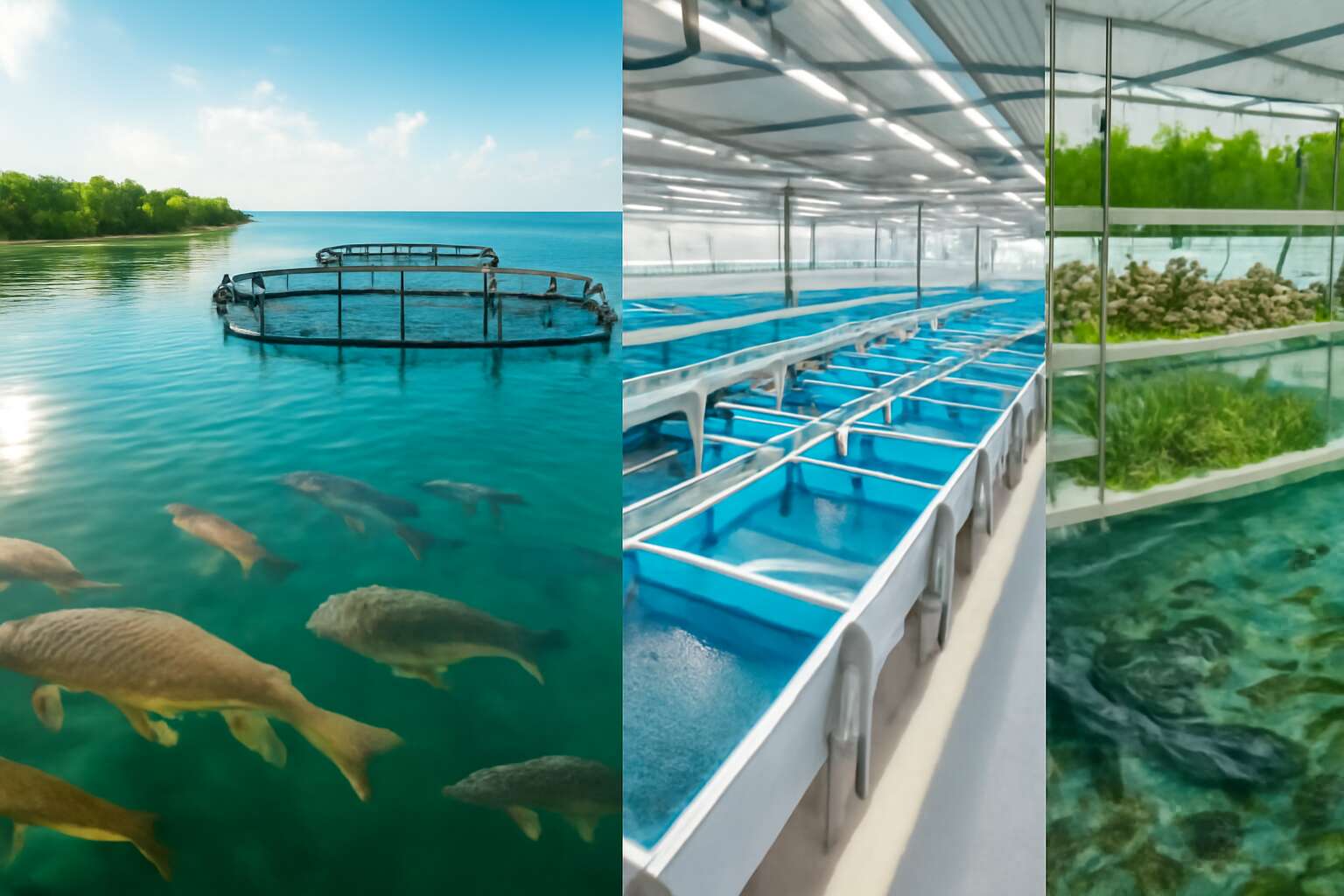
Overview of Aquaculture Classification: Why It Matters
Ways to classify aquaculture into categories
Across oceans and estuaries, the quiet boom of protein reaches millions; aquaculture can be classified into essential streams that shape sustainability. Globally, aquaculture accounts for more than 50% of seafood by production, a milestone that reframes how cities eat!
To map its scope, the field is classified into three primary lenses: water type, production system, and lifecycle stage.
- By water body: freshwater, brackish, marine
- By production system: ponds, cages, recirculating systems
- By lifecycle stage: hatchery, grow-out, harvest-ready finish
In South Africa, this taxonomy shapes decisions about feed, energy, and regulatory alignment, helping farms balance coastline realities with market demand. This approach makes the broader field legible to partners and policymakers.
Key classification frameworks: species-based, system-based, and geography-based
More than half of the seafood we eat worldwide comes from aquaculture, a blue economy that speaks softly of abundance and responsibility! This is the idea: aquaculture can be classified into three guiding frames that sharpen strategy, illuminate risk, and empower partners. When clarity arrives, investment follows, and best practices become shared language across farms and regulators.
The three frames include:
- Species-based: grouping by species traits to guide feed, health, and markets.
- System-based: classification by ponds, cages, or recirculating setups to map efficiency and waste.
- Geography-based: placement by location and regulatory landscapes that shape access and compliance.
In South Africa, these lenses guide decisions on feed, energy, and regulatory alignment.
Why classification matters for investors, policymakers, and farmers
Across South Africa’s coastline and rural bays, the blue economy beats with quiet promise. More than half of the seafood we eat worldwide comes from aquaculture, a steady source of livelihoods and nourishment that asks for mindful stewardship. aquaculture can be classified into guiding lenses that sharpen strategy and align partners.
Classification matters because it turns risk into plan and policy. For investors, it clarifies where capital belongs. For policymakers, it maps priorities and safeguards. For farmers, it points to feed, energy use, and community access.
From the farmer on a sunlit quay to the city investor, classification shapes who pays, who regulates, and who benefits. I’ve seen how a shared language turns uncertainty into collaboration and keeps the coast resilient.
Common misclassifications and how to avoid them
Across South Africa’s coastlines, the blue economy whispers of possibility and responsibility. Understanding how to label this vast practice matters; it shapes investment, policy, and everyday work on the quay. aquaculture can be classified into interwoven threads—yet labels, when muddled, turn risk into doubt and doubt into delay. A clear map helps communities, financiers, and regulators align toward resilient harvests, clean oceans, and fair access.
Common misclassifications creep in when labels outpace reality.
- Geography-only labels collapse diverse farming systems and species into one bucket. Avoid by cross-referencing with system- and species-based criteria in regulatory frameworks.
- Scale or output is mistaken for sustainability; big farms aren’t automatically better.
- End-use labels may miss on-the-ground realities; verify practices against documented methods.
Clear categories, grounded in local practice, keep the coast resilient.
Classification by Production System
Pond, raceway, and tank systems: defining production environments
In the quiet dance of water and life, production environments set the stage. aquaculture can be classified into ponds, raceways, and tanks, each offering a distinct rhythm for growth and care, a map for South Africa’s coastal farms and inland ventures.
Ponds capture natural light and sun-warmed currents, often sprawling and forgiving. They suit adaptable species and seasonal cycles, yet water quality can drift with weather, demanding vigilant management and a steady eye on sediment and nutrients.
- Ponds: open or lined expanses, broad footprints, gentle energy needs
- Raceways: long, closed channels with continuous flow for stability and efficiency
- Tanks: closed or recirculating systems, high control over water quality and biosecurity
Each environment offers its own rhythm of feeding schedules, health management, and harvest timing, inviting careful alignment with species, climate, and market demand.
Recirculating Aquaculture Systems vs. open-pond culture: comparing characteristics
Production systems steer the rhythm of growth. In this lens, aquaculture can be classified into two main pathways: Recirculating Aquaculture Systems (RAS) and open-pond culture. RAS emphasizes closed loops, meticulous water treatment, and tight biosecurity, translating into stable performance but higher capital and energy demands. Open-pond culture leans on sunlight and natural currents, delivering lower upfront costs yet greater exposure to climate swings and effluent considerations in South Africa’s diverse landscapes.
- RAS: precise water quality, biosecurity, and feed control, with year-round productivity
- Open-pond: solar-driven, lower capital, but weather dependence and nutrient management challenges
- Hybrid concepts: combine the strengths of both within site-specific constraints
How these systems perform in South Africa’s coastlines and inland pockets depends on scale, water rights, and market tempo—factors that shape risk and opportunity in quiet, measured ways.
Open-water cages and offshore farming: when and where they fit
“Growth is a patient tide,” a veteran grower once told me, and our coast agrees. In the bustling SA landscape, aquaculture can be classified into production pathways that ride the rhythm of the sea—open-water cages and offshore farming leading the charge!
Open-water cages and offshore farming fit when currents and depth favor safe, scalable operations. Where the shelf drops away and waves are predictable, these systems can bloom with less capital, slower but steadier workflows, and a keen eye on environmental footprint. They’re ideal in SA’s coastal zones that meet regulatory clarity and access to feed logistics and monitoring.
Key considerations for site-readiness include:
- depth and current stability
- water quality and ecological impact
- permit regimes and logistical access
Beyond classification, these systems frame a story of risk, resilience, and regional opportunity across South Africa’s coast and inland pockets.
Integrated multi-trophic aquaculture approaches (IMTA) versus conventional systems
“The ocean returns what you learn to listen for,” a veteran SA grower once told me. In this realm, aquaculture can be classified into two broad production logics: Integrated multi-trophic aquaculture (IMTA) and conventional systems. IMTA links species so waste becomes feed, creating resilience and a lighter environmental footprint—concepts already taking root along South Africa’s coast and in inland pockets.
- IMTA recycles nutrients by pairing species, boosting biosecurity and revenue streams
- Conventional systems concentrate on straightforward production with predictable growth curves
- Site selection hinges on ecological compatibility, regulatory clarity, and feed logistics
Both approaches tell a story of sustainability, scale, and regional opportunity that invites investors and farmers to imagine new futures along South Africa’s aquaculture coastline.
Classification by Species and Product Type
Finfish, shellfish, and aquatic plants: core categories
From the shore to the inland hatchery, a single frame of reference drives planning: aquaculture can be classified into three core categories—finfish, shellfish, and aquatic plants—and each maps to distinct husbandry, markets, and risks. I’ve watched teams breathe easier when this triad acts as a map, and this taxonomy acts as a compass for South Africa’s evolving aquaculture sector, guiding where to invest, what to feed, and how to reach consumers with integrity.
- Finfish — species harvested for flesh, from coastwise trout to popular reef‑side tilapia, adaptable to tanks, raceways, or open-water cages
- Shellfish — molluscs and crustaceans that thrive on nutrient-rich water and efficient filtration
- Aquatic plants — seaweeds and other aquatic flora that convert nutrients into high‑value biomass
The three categories aren’t mere labels; they reflect ecosystems, supply chains, and consumer preferences. For a country with vast coastlines and inland reservoirs, choosing the right category shapes resilience and growth, turning quiet waters into relevant markets!
Popular farmed species by market demand: tilapia, salmon, shrimp, seaweed
Across South Africa’s coastline and inland basins, a quiet truth pushes through the fog: aquaculture can be classified into finfish, shellfish, and aquatic plants—three life-systems that act as a compass through dawn light and market storms. Last year, SA’s aquaculture output rose by about 7%, a lantern in the dim room of protein supply. These pillars are not mere labels; they sculpt ecosystems, supply chains, and consumer yearning, shaping resilience against drought, price swings, and shifting policy currents.
Classification by Species and Product Type binds markets to the shapes of pens and ponds. Popular farmed species by market demand include:
- tilapia
- salmon
- shrimp
- seaweed
Product forms: live, fresh, frozen, and value-added products
Across South Africa’s coastlines and inland basins, a quiet current powers meals and livelihoods. aquaculture can be classified into three life-systems, anchoring supply to markets and menus alike. The split isn’t a cagey label; it maps the rhythms of growth, care, and consumer desire.
Product forms ride along that spectrum, shaping how producers package value and how buyers plan meals.
- live
- fresh
- frozen
- value-added
From pens to plate, the journey tunes texture, freshness, and resilience. Each form carries a story of water, feed, and skilled hands that translate ocean breath into everyday protein.
Specialized farming: mollusks and crustaceans with distinct classification criteria
A quiet tide powers meals and livelihoods from South Africa’s sunlit coasts to inland basins. “The pen is the new frontier for protein,” a SA aquaculture voice quips, and the demand confirms it. In this framework, aquaculture can be classified into species-driven and product-focused streams that shape what farms grow and how markets respond.
Specialized farming centers on mollusks and crustaceans, each with distinct classification criteria. Mollusks—such as mussels, oysters, and scallops—often hinge on shell type and habitat; crustaceans—shrimp, prawns, crabs, lobsters—depend on body plan and life cycle. These rules guide feed, water quality, and harvest timing, weaving into practical value chains.
- Mollusks: mussels, oysters, scallops
- Crustaceans: shrimp, prawns, crabs, lobsters
From pen to plate, product forms—live, fresh, frozen, and value-added—work with species biology to shape handling, logistics, and dining experiences across SA. This approach clarifies how aquaculture can be classified into practical streams.
Classification by Geography and Climate
Global regions and climate zones shaping aquaculture classification
More than half of the world’s seafood now comes from aquaculture. In practice, aquaculture can be classified into geographic and climate-based frameworks that map where production thrives. That map reveals which species and systems fit local conditions, including Southern Africa.
Global regions and climate zones shape what is grown and how. The following patterns emerge:
- Tropics and subtropics favor seaweeds, tropical fish, and warm-water shrimp
- Temperate zones support salmon, mussels, and cool-water carp
South Africa’s coastline and climate present a nuanced landscape: the east coast’s warmth meets the Western Cape’s cooler seas, inviting climate-smart farming while underscoring the need for resilient infrastructure and water stewardship!
Temperate vs tropical systems: implications for species and gear
Across South Africa, coastal diversity proves a masterclass in climate-smart farming. More than half of the world’s seafood now comes from aquaculture, and aquaculture can be classified into geography-based and climate-based frameworks that map where production thrives. From the wind-buffeted Western Cape to the sun-warmed eastern seaboard, where farms are located shapes what is harvested.
Temperate regions favor salmon, mussels, and cool-water carp, demanding stable temperatures, careful water flow, and gear that cushions thermal swings! Tropical belts favor seaweeds, tropical fish, and warm-water shrimp, where rapid growth rides on heat and robust aeration.
- Temperate systems rely on tight temperature control, recirculating units, and biofiltration.
- Tropical systems lean on rapid-water turnover, suspended solids management, and resilient cages.
Along South Africa’s coast, this means pairing the right species with climate-smart infrastructure and water stewardship; the result is resilient farms that meet local demand while protecting scarce resources.
Water source classifications: freshwater vs marine vs brackish
Across South Africa’s windswept coastlines, where aquaculture now accounts for roughly half of global seafood, place shapes harvests as much as biology does. aquaculture can be classified into geography-based and climate-based frameworks that map where production thrives; by the shore, farms align with tides, estuaries, and water access. From the Western Cape’s braided bays to the sunlit eastern seaboard, location dictates what survives and how it’s grown.
Water source classifications crystallize into freshwater, marine, and brackish systems. Freshwater ponds inland nurture tilapia and carp; marine pens anchor oysters, sea bass, and shrimp along the coast; brackish nurseries in estuaries support species that tolerate variable salinity and provide resilience against storms.
- Freshwater: tilapia, carp
- Marine: oysters, sea bass
- Brackish: shrimp, certain seaweeds
Environmental, Economic, and Policy Classification
Sustainability criteria: environmental impact and certification schemes
aquaculture can be classified into environmental, economic, and policy lenses—the triad of sustainability. Environmental impact is the first test: waste, water and energy use, and habitat effects. Certification schemes provide independent proof, with ASC, GlobalG.A.P., and Friend of the Sea guiding performance!
- ASC – Aquaculture Stewardship Council
- GlobalG.A.P. Aquaculture
- Friend of the Sea
Eeconomic sustainability weighs costs, market access, and resilience. Certification can unlock premiums and transparent supply chains, boosting investor confidence in South Africa’s seafood sector.
Policy alignment anchors farming in law and public priorities. Licensing, water rights, and environmental assessments shape feasibility; certification schemes often align with policy goals, easing approvals and export readiness.
Economic viability, scale, and supply chain considerations
Aquaculture can be classified into environmental, economic, and policy lenses—the triad that guides every farm decision. Environmental stewardship begins with waste, water, and energy use, plus habitat effects. In South Africa, dawn light on coastal pens reminds communities how intimately farming touches place and people.
Economic viability hinges on scale, efficiency, and resilient supply chains. Larger operations gain from economies of scope; smaller farms win when connected to local markets with transparent traceability. A robust network lowers risk for investors and can unlock premium pricing, turning sustainability into steady livelihoods.
- Scale economies and efficient procurement
- Transparent traceability in supply chains
- Access to financing and premium markets
Policy alignment anchors farming in law and public priorities. Licensing, water rights, and environmental assessments shape feasibility; certification schemes often align with policy goals, easing approvals and export readiness.
Regulatory frameworks and standards that define classification (codes, licenses, certifications)
Coastal communities in South Africa know that regulation isn’t a distant rulebook; it shapes livelihoods. The idea that aquaculture can be classified into regulatory layers helps us see where protections begin and how farms must operate. Environmental classifications set codes on habitat impact, effluent, and marine safety, guiding permit processes and site selection with care for reefs and shorelines.
Economic classification emphasizes licenses, permits, and transparent records that affect access to finance and market trust. When codes and standards are clear, farmers can plan, invest, and partner with buyers who demand traceability and responsible sourcing. This alignment makes sustainable growth more predictable and ensures communities benefit from resilient local supply chains.
Policy-based classification ties these rules to public priorities, weaving licensing, water rights, and environmental reviews into a coherent system. In practice, a well-defined framework eases approvals and supports certifications that signal quality and sustainability to buyers and regulators alike.
- Codes and guidelines
- Licenses and permits
- Certifications and audit schemes
Climate resilience and risk factors in classification decisions
Coastlines that feed communities also carry risk. In South Africa, coastal farms have faced a 15% yield dip during heatwaves in the past decade. That reality isn’t optional. When we consider how aquaculture can be classified into environmental, economic, and policy layers, climate resilience becomes a practical compass for decision-making. Environmental classification guides site selection, habitat protection, and effluent controls, with reef and shoreline integrity as touchstones.
- Rising sea surface temperatures and altered currents
- Salinity and fresh-water balance shifts
- Increased storm frequency and magnitude
Economic classification ties permits, finance, and traceability to the risk profile of a farming operation. Clear risk signals help lenders price insurance, investors diversify, and buyers demand resilient supply chains that weather climate shocks.
Policy classification weaves licenses, water rights, and environmental reviews into a coherent governance fabric. Strong rules reduce uncertainty, support certifications, and align investment with public priorities for coastal communities.

0 Comments